FOR REGISTERED CLINICIANS ONLY — decision support, not a substitute for clinical judgement or local protocol.
Pelvic trauma · NG37 & NG39
The binder over the trochanters, the resuscitation restrictive, the imaging by whether they respond.
A suspected pelvic fracture after high-energy blunt trauma is a bleeding problem before it is an orthopaedic one. This module runs the NICE major trauma (NG39) and complex fractures (NG37) recommendations as one pathway — binder, tranexamic acid, the 1:1 ratio, the imaging route that changes with haemodynamic status, and interventional radiology versus pelvic packing — and adds the one thing NICE does not say: where on the pelvis the binder actually goes.
NICE NG37 (2016)
NICE NG39 (2016)
Adults and under-16s
“If active bleeding is suspected from a pelvic fracture following blunt high‑energy trauma: apply a purpose‑made pelvic binder, or consider an improvised pelvic binder but only if a purpose‑made binder does not fit.”
NICE NG37, recommendation 1.1.7 (identical to NG39 1.5.3)
Where this fits. This module covers the resuscitation-room decisions for a suspected pelvic fracture: binder, blood, tranexamic acid, imaging and the route to haemorrhage control.
It does not replace your major haemorrhage protocol, the trauma team, or the pelvic surgeon and interventional radiologist you will be calling. For reversing an anticoagulant it points you to the
bleeding & reversal module; for the older patient who fell from standing, the physiology and the injuries found late are in the silver trauma module.
1
Age and mechanism
The binder and CT-first-line rules are written for high-energy blunt trauma, and some recommendations name adults or children specifically.
AGE
MECHANISM
2
Haemodynamic status — and the response to resuscitation
This single axis decides the imaging route and how fast the patient leaves the resus room. NICE uses the response to volume, not one blood-pressure reading.
A pelvic bleed can be a normal blood pressure with a rising heart rate, then sudden collapse. Young patients compensate until they do not. Treat a transient responder — up with a fluid bolus, down again — as an active bleeder, not as stable.
3
Is active bleeding from a pelvic fracture suspected?
NICE ties the binder to suspected active bleeding from a pelvic fracture, not to a confirmed one. Any of these, with the right mechanism, is enough to suspect it.
Do not spring the pelvis to test it. Repeatedly rocking a fractured pelvis can dislodge clot and worsen bleeding, and a single examination is unreliable. Suspicion rests on mechanism plus findings; the binder and CT settle it. Do not log roll before pelvic imaging unless the airway needs clearing or an occult penetrating injury is suspected in an unstable patient (NG37 1.2.19).
4
Context
Changes which haemorrhage-control route applies, whether to reach for reversal, and where the patient goes next.
5
The pathway for this patient
Binder, resuscitation, imaging and haemorrhage control, each reported separately and recalculated as you change anything above.
Answer step 1 to begin.
The reference
Applying the binder — and the one thing NICE does not say
When. “If active bleeding is suspected from a pelvic fracture following blunt high‑energy trauma: apply a purpose‑made pelvic binder, or consider an improvised pelvic binder but only if a purpose‑made binder does not fit.” (NG37 1.1.7; word-for-word the same as NG39 1.5.3.)
Where — the practice point NICE leaves out
Neither NG37 nor NG39 says where on the pelvis the binder sits. The near-universal teaching, and the instructions supplied with every purpose-made device, is to centre it over the greater trochanters — the bony points you can feel at the widest part of the hips — not over the iliac crests, where it is most often placed wrongly. A binder over the crests does not close the pelvic ring and can splint it open. This is a technique point from device instructions and standard trauma teaching, not from NICE; it is flagged as such because the rest of this module is national guidance and this is not.
Straighten and gently bring the legs together, and internally rotate them, before or as the binder is tightened — this helps close the ring. Tie or tape the ankles/knees to hold the position.
Remove hard objects from pockets under the binder (keys, phones) — they cause pressure necrosis under a binder that may stay on for hours.
One binder, correctly placed and tightened, is the intervention. It tamponades venous and bony bleeding and reduces the pelvic volume; it does not control arterial bleeding, which is why an arterial bleed still needs interventional radiology or packing.
NICE NG37 recommendation 1.1.7 · NICE NG39 recommendation 1.5.3 · placement/technique: manufacturer instructions for use and standard trauma teaching, not NICE
Resuscitation and haemostatic control (NG39 1.5)
Restrictive volume resuscitation
“For patients with active bleeding use a restrictive approach to volume resuscitation until definitive early control of bleeding has been achieved.” (1.5.18)
In hospital, “move rapidly to haemorrhage control, titrating volume resuscitation to maintain central circulation until control is achieved.” (1.5.20)
“In hospital settings do not use crystalloids for patients with active bleeding.” (1.5.23)
Blood component ratio
Adults (16 or over): “use a ratio of 1 unit of plasma to 1 unit of red blood cells to replace fluid volume.” (1.5.24)
Children (under 16s): “use a ratio of 1 part plasma to 1 part red blood cells, and base the volume on the child’s weight.” (1.5.25)
“For patients with active bleeding, start with a fixed‑ratio protocol for blood components and change to a protocol guided by laboratory coagulation results at the earliest opportunity.” (1.5.27)
Traumatic brain injury alongside the bleed
“For patients who have haemorrhagic shock and a traumatic brain injury: if haemorrhagic shock is the dominant condition, continue restrictive volume resuscitation or if traumatic brain injury is the dominant condition, use a less restrictive volume resuscitation approach to maintain cerebral perfusion.” (1.5.21)
Activating the major haemorrhage protocol
“Use physiological criteria that include the patient’s haemodynamic status and their response to immediate volume resuscitation to activate the major haemorrhage protocol.” (1.5.13)
“Do not rely on a haemorrhagic risk tool applied at a single time point to determine the need for major haemorrhage protocol activation.” (1.5.14)
“Use intravenous tranexamic acid as soon as possible in patients with major trauma and active or suspected active bleeding.” (1.5.4)
“Do not use intravenous tranexamic acid more than 3 hours after injury in patients with major trauma unless there is evidence of hyperfibrinolysis.” (1.5.5)
In February 2016 this was an off-label use of tranexamic acid. NG39 gives no dose; the widely used CRASH-2 regimen is 1 g IV over 10 minutes then 1 g over 8 hours — check your local major haemorrhage protocol, and see the drug monographs.
NICE NG39, recommendations 1.5.4–1.5.5
Imaging, by haemodynamic status
Situation
What NICE says
Unstable, not responding
“Limit diagnostic imaging (such as chest and pelvis X‑rays or FAST…) to the minimum needed to direct intervention” (NG39 1.5.29). Do not delay haemorrhage control for imaging.
Responding, or normal
“Consider immediate CT for patients with suspected haemorrhage if they are responding to resuscitation or if their haemodynamic status is normal” (NG39 1.5.31).
High-energy pelvic fracture, adult
“Use CT for first-line imaging in adults (16 or over) with suspected high‑energy pelvic fractures” (NG37 1.2.14).
High-energy pelvic fracture, child
CT rather than X-ray when abdomen/pelvis CT is already indicated for other injuries; consider CT rather than X-ray when it is not, limiting CT to the areas needed (NG37 1.2.15).
Blunt major trauma, multiple injuries, adult
Whole-body CT — vertex-to-toes scanogram then vertex to mid-thigh, without repositioning (NG39 1.5.34).
Children
“Do not routinely use whole‑body CT to image children (under 16s).” Limit CT to the areas needed (NG39 1.5.36 / NG37 1.2.10).
FAST
“Be aware that a negative FAST does not exclude intraperitoneal or retroperitoneal haemorrhage” (1.5.30). “Do not use FAST as a screening modality to determine the need for CT” (1.5.33), and do not use it before immediate CT (1.5.32).
Controlling the bleeding — IR, packing, damage control
Active arterial pelvic bleeding, first-line invasive treatment (NG37 1.2.16): interventional radiology if emergency laparotomy is not needed for abdominal injuries; pelvic packing if emergency laparotomy is needed for abdominal injuries.
NG39 1.5.40: “Use interventional radiology techniques in patients with active arterial pelvic haemorrhage unless immediate open surgery is needed to control bleeding from other injuries.”
Damage control surgery (NG39 1.5.37): use it “in patients with haemodynamic instability who are not responding to volume resuscitation.” Consider definitive surgery if responding (1.5.38); use definitive surgery if haemodynamic status is normal (1.5.39).
Transfer (NG37 1.2.11): “Immediately transfer people with haemodynamic instability from pelvic or acetabular fractures to a major trauma centre for definitive treatment of active bleeding.” Those needing specialist reconstruction go to an MTC or specialist centre within 24 hours (1.2.12).
A pelvic binder controls venous and bony bleeding by tamponade; it does not stop arterial bleeding. A patient who stays unstable with a correctly applied binder has arterial bleeding until proven otherwise — that is the IR/packing decision, made with the trauma team, not delayed for more imaging.
“For people with suspected pelvic fractures and pelvic binders, remove the binder as soon as possible if:” (NG37 1.2.17)
there is no pelvic fracture, or
a pelvic fracture is identified as mechanically stable, or
the binder is not controlling the mechanical stability of the fracture, or
there is no further bleeding or coagulation is normal.
“Remove all pelvic binders within 24 hours of application.” And before removing it: “Before removing the pelvic binder, agree with a pelvic surgeon how a mechanically unstable fracture should be managed.” (1.2.18)
The 24-hour limit matters in the ED because the binder that saved the patient becomes a pressure-injury risk. Skin necrosis under a binder is a recognised complication; the decision to keep it beyond a few hours is a surgical one, not a default.
NICE NG37, recommendations 1.2.17–1.2.18
Anticoagulation, heat and pain
Anticoagulation (NG39 1.5.6–1.5.12)
“Rapidly reverse anticoagulation in patients who have major trauma with haemorrhage” (1.5.6), and “do not reverse anticoagulation in patients who do not have active or suspected bleeding” (1.5.12).
Adults on a vitamin K antagonist with active bleeding: “use prothrombin complex concentrate immediately” (1.5.8); “do not use plasma to reverse a vitamin K antagonist” (1.5.9).
Any other anticoagulant in an adult, or any anticoagulant in a child: consult a haematologist immediately (1.5.10, 1.5.11).
“Minimise ongoing heat loss in patients with major trauma.” Hypothermia, acidosis and coagulopathy are the lethal triad; the exposed, wet, transfused pelvic-trauma patient is the one who gets cold.
Pain (NG39 1.7.4–1.7.6)
“Use intravenous morphine as the first‑line analgesic and adjust the dose as needed to achieve adequate pain relief.” If no IV access, consider intranasal atomised diamorphine or ketamine (off-label in 2016); ketamine in analgesic doses is the named second-line agent. No doses in NG39; use the drug monographs and, for children, the paediatric tool.
The decision tool tells you what to do. This chapter is about why — the anatomy that makes a broken pelvis a bleeding problem, the reasoning behind every step, the mistakes that are made in real resus rooms, and the findings that look reassuring and are not. It is meant to be read before the shift, not during it.
NICE UK national guidance, verbatimWSES World Society of Emergency Surgery 2017, with its gradeRCT randomised trialObservational cohort, case series or case reportTeaching standard anatomy or trauma teaching, not guidance
Who this is about. Almost everything below comes from adult or unstated-age series: CRASH-2 enrolled adults and UK-REBOA enrolled patients aged 16 or older, and none of the pelvic studies was designed around children. The NICE recommendations apply to children and adults unless they name an age group, and the decision tool branches on age. For a child, use the tool’s paediatric branches and your paediatric major trauma centre — do not carry the numbers in this chapter across.
A case to hold in mind · illustrative, not a real patient
A 34-year-old motorcyclist is brought in after a high-speed collision. GCS 15, heart rate 118, blood pressure 124/78. He has pelvic pain. The paramedics have applied a pelvic binder; it sits across his waist, level with the iliac crests. Someone has sprung his pelvis in the bay and says it “feels stable”. There is a spot of blood at the urethral meatus and the nurse is opening a catheter pack. The trauma CT reports no pelvic fracture.
By the end of this chapter you should be able to name at least five things in that paragraph that are wrong, or reassuring for the wrong reason. They are listed at the bottom.
The whole pathway
Why we do what we do, in one table
Every step in the decision tool, and the reason it is there.
What we do
Why
Basis
Binder on suspicion, not on proof
It reduces the volume of a disrupted ring and brings bleeding bone ends and torn veins together — and the proof (the CT) comes after the time it matters most.
NG37 1.1.7WSES 1A
Over the greater trochanters
A binder above them compresses the wrong part of the pelvis; in one series the symphyseal gap was 2.8 times wider when it sat high.
Bonner 2011device IFU
Do not spring the pelvis
It misses most unstable fractures and can dislodge clot.
Shlamovitz 2009WSES text
No log roll before pelvic imaging
Rolling a mechanically unstable ring moves it.
NG37 1.2.19
Blood, not crystalloid; 1:1; restrictive
You are replacing lost blood and clotting capacity while buying time for haemorrhage control, not normalising a blood pressure.
NG39 1.5.18–1.5.27
TXA early, never after 3 hours without hyperfibrinolysis
It reduced death in bleeding trauma patients; NICE sets the 3-hour limit, and the timing evidence is in the drug monograph.
NG39 1.5.4–1.5.5CRASH-2
Unstable, not responding: minimum imaging
The scanner is not a place of safety; the treatment is in theatre or the IR suite.
NG39 1.5.29
Still unstable with a good binder: think arterial
A binder tamponades veins and bone. It cannot close a bleeding artery.
WSES textNG37 1.2.16
IR if no laparotomy; packing if laparotomy
Use the route that gets to haemorrhage control fastest without abandoning the abdomen.
NG37 1.2.16
Binder off within 24 h, only after a pelvic surgeon agrees
The device that saved the patient becomes a pressure injury — but taking it off a still-unstable ring can restart the bleed.
NG37 1.2.17–1.2.18
Chapter 1
The pelvis is a ring, and rings rarely break in one place
Why a pelvic fracture is a vascular injury wearing an orthopaedic label.
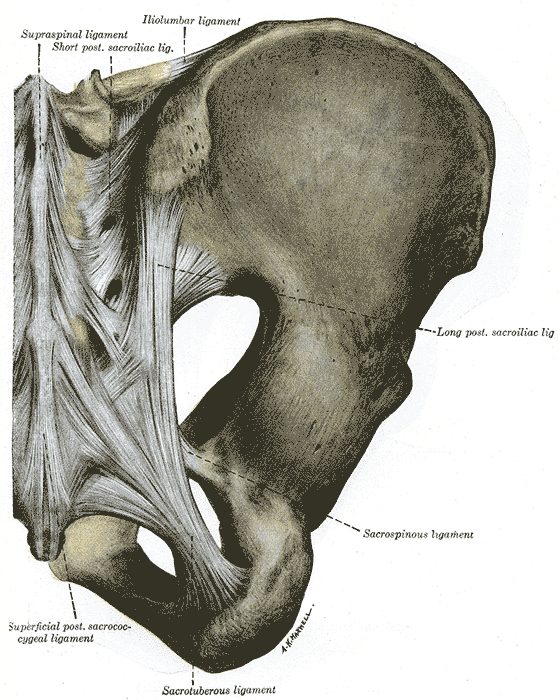
The pelvic ring is three bones — the sacrum behind and the two innominate bones either side — joined at the pubic symphysis in front and the sacroiliac joints behind. The bones alone would fall apart; what holds the ring together is ligament, and most of the strength sits posteriorly, in the sacroiliac, sacrotuberous and sacrospinous ligaments shown below. Anatomy
The posterior ligament complex. This is what keeps the ring closed. An injury that opens the front of the ring widely has usually torn some of these too — which is why “just a symphysis diastasis” is rarely just that.Gray H. Anatomy of the Human Body (1918), Fig. 320, “Posterior articulations of pelvis” — H. V. Carter. Public domain, via Wikimedia Commons.
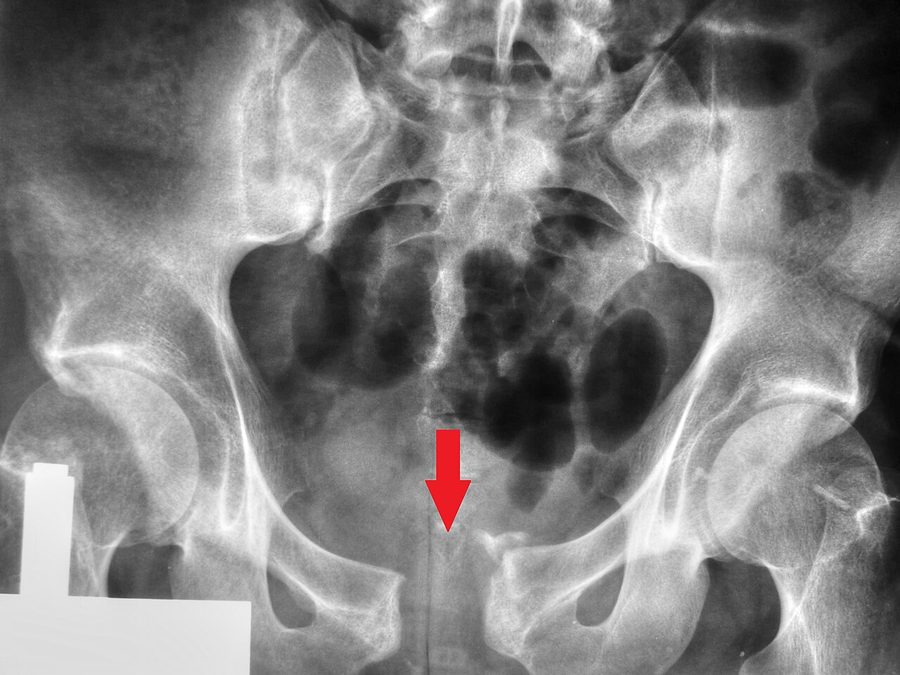
Because it is a ring, a force strong enough to break it in one place usually disrupts it somewhere else as well — often at the back, where it is harder to see on a plain film. Teaching When the ring opens, two things happen. The volume of the pelvis increases, and the tissue planes that would otherwise tamponade bleeding are torn. WSES describes exactly this: instability “and a consequent increase in the internal volume”, particularly in open-book injuries, which facilitates retroperitoneal haemorrhage “by reducing the tamponing effect (pelvic ring can contain up to a few liters of blood)”. WSES 2017 p.3
An open-book injury. The arrow marks the widened pubic symphysis. Picture the book opening: the front springs apart, the sacroiliac joints behind act as the hinge, and the space inside the pelvis — the space blood can fill — gets bigger.“Post traumatic open book pelvis fracture and significant diastasis in the symphysis pubis.” Nevit Dilmen, CC BY-SA 3.0, via Wikimedia Commons. Resized, otherwise unaltered.
Four ways to break a ring
The Young–Burgess classification groups injuries by the direction of force: anteroposterior compression (the open book), lateral compression (the ring is pushed in, not out), vertical shear (one half driven up relative to the other) and combined mechanism. WSES 2017 p.8 It is a surgeon’s classification, made from the CT, and the decision tool deliberately does not ask for it.
Why the tool starts with physiology, not the fracture
Because the fracture pattern does not tell you who is bleeding. WSES says so bluntly: “there is a poor correlation between the grade of the radiological lesions and the need for emergent hemostasis”, and it builds its own classification around haemodynamic status for that reason. WSES 2017 p.4 A “minor-looking” fracture in a shocked patient is a bleeding pelvis until proven otherwise.
Chapter 2
Where the blood comes from
The single fact that explains the binder, the packing and the angiogram.
Most pelvic fracture bleeding is not arterial. It comes from the presacral and prevesical venous plexuses and from the raw cancellous bone surfaces of the sacrum and ilium. WSES 2017 pp.2–3, 10 The arteries that do bleed are branches of the internal iliac: the pudendal and obturator arteries anteriorly, the superior gluteal and lateral sacral arteries posteriorly.
80–90%of bleeding in unstable pelvic ring disruption attributed to venous and bony sources
10–20%arterial
~100%chance of concomitant venous bleeding when an artery is bleeding
All three from WSES 2017 p.10–11. The same guideline also gives “veins (80%) and … arteries (20%)” on p.2 and “85%” on p.12 — treat these as estimates, not measurements.
Hold that proportion in your head and the whole management sequence makes sense:
The binder closes the ring and apposes the bone ends and torn veins — it treats the majority source.
Pre-peritoneal packing physically compresses the venous plexus against a stabilised pelvis. WSES notes it is “not effective in absence of adequate counterpressure by posterior pelvic elements”, which is why packing and pelvic stabilisation go together. WSES 2017 p.12
Angioembolisation treats the minority arterial source extremely well — and cannot treat venous bleeding. WSES records that angioembolisation-only strategies have been associated with high mortality. WSES 2017 pp.11–12
Why “still unstable despite the binder” means artery
If the binder is on and correctly placed, the venous and bony component has been addressed as well as it can be. WSES: “Arterial bleeding may be predominant in patients with persistent hemodynamic instability after mechanical stabilization.” WSES 2017 p.11 That is the patient the NICE IR-versus-packing decision is written for.
One more point that matters in the resus room: as many as 90% of patients with unstable pelvic fractures have significant associated injuries, and bleeding in the chest, abdomen or limbs may need controlling before the pelvis does. WSES 2017 pp.12–13 The pelvis is a common source of shock, not the only one.
Chapter 3
The binder: simple, effective, and usually in the wrong place
What it does, where it goes, and what it cannot do.
A pelvic binder is a belt that pulls the two halves of an opened ring back together. Cadaver work showed it reduces pelvic volume, and clinical series confirmed the effect in patients. WSES 2017 p.9 NICE asks for a purpose-made binder when active bleeding from a pelvic fracture is suspected after blunt high-energy trauma, and an improvised one only if a purpose-made one does not fit. NG37 1.1.7 WSES grades purpose-made binders as superior to sheet wrapping. WSES 1C
Where it goes — and where it actually goes
The binder is centred over the greater trochanters. WSES describes the right position as “around the great trochanter and the symphysis pubis”, with the lower limbs adducted to reduce the internal volume. WSES 2017 pp.8–9 NICE does not state placement at all. Device instructions
The instinct is to put it round the “hips” — which most people locate at the iliac crests, the waistband. That is too high. When a military hospital reviewed 167 radiographs with a visible binder buckle, only 50% were at the level of the trochanters and 39% were too high; in the open-book subgroup, the symphyseal gap was on average 2.8 times wider (22 mm) with a high binder. Bonner 2011 A UK major trauma centre found 50.9% of 110 binders unsatisfactorily placed, and 30 of 67 patients with a pelvic ring injury had no binder at all. Naseem 2018
How to find the trochanters in a hurry
Run your hand down the side of the thigh from the iliac crest: the bony prominence you reach, roughly level with the pubic symphysis, is the greater trochanter. Centre the binder there, bring the legs together and internally rotate them, and tape the knees and ankles. Empty the pockets under the binder first. Teaching
What the binder cannot do
It does not stop arterial bleeding — see Chapter 2.
It has not been shown to reduce mortality on its own. WSES: “The use of PB alone doesn’t seem to reduce mortality.” WSES 2017 p.9 What it has been associated with is less transfusion than emergent external fixation, in a retrospective series — see the Evidence tab.
It is not harmless over time. WSES links skin necrosis to sustained pressure above 9.3 kPa for more than 2–3 hours, and recommends removing binders as soon as physiologically justifiable. WSES 1B NICE sets the outer limit at 24 hours. NG37 1.2.17
It needs thought in pregnancy and in older people.WSES 2A — “positioned cautiously”, not avoided.
Chapter 4
Examining the pelvis: ask, look, press gently — do not spring
The manoeuvre everyone learned is the one least worth doing.
Springing, rocking or compressing the iliac wings to feel for movement is a traditional part of the secondary survey. It performs badly. In a retrospective review of 1,502 consecutive blunt trauma patients (115 pelvic fractures, 34 mechanically unstable), an unstable ring on examination detected only 26% of the mechanically unstable fractures. Shlamovitz 2009 It is specific — if you feel it move, it is broken — but a “stable” pelvis on springing tells you almost nothing.
And it has a cost. WSES warns that the manoeuvre “should be done cautiously because it can sometime increase the bleeding by dislocating bones margin”. WSES 2017 p.6
26%sensitivity of an unstable ring on examination for a mechanically unstable fracture
55%sensitivity of visible pelvic deformity
100%sensitivity of pelvic pain or tenderness — but only in patients with GCS >13 (95% CI 85–100; 34 unstable fractures). Not validated to clear the pelvis; intoxication and distracting injury still count
Shlamovitz 2009, J Trauma. Retrospective, single study, 34 unstable fractures — a small number to hang a 100% on.
What to do instead
In the alert patient, ask about pain and palpate gently. Look for bruising, perineal or scrotal haematoma, leg-length discrepancy or rotation, and blood at the meatus. In the patient who cannot be examined reliably — reduced GCS, intoxicated, intubated, distracted by another injury — do not examine your way to reassurance at all: with a high-energy mechanism, assume the fracture, bind, and let the CT decide. That is exactly how the decision tool’s step 3 is built.
Chapter 5
The scan that lies: imaging a pelvis that has been put back together
A binder that works makes the CT look better than the patient is.
For a haemodynamically normal or responding adult with a suspected high-energy pelvic fracture, CT is first-line. NG37 1.2.14 For the unstable patient who is not responding, imaging is limited to the minimum needed to direct intervention. NG39 1.5.29 So far, so familiar. The trap is what the CT is looking at.
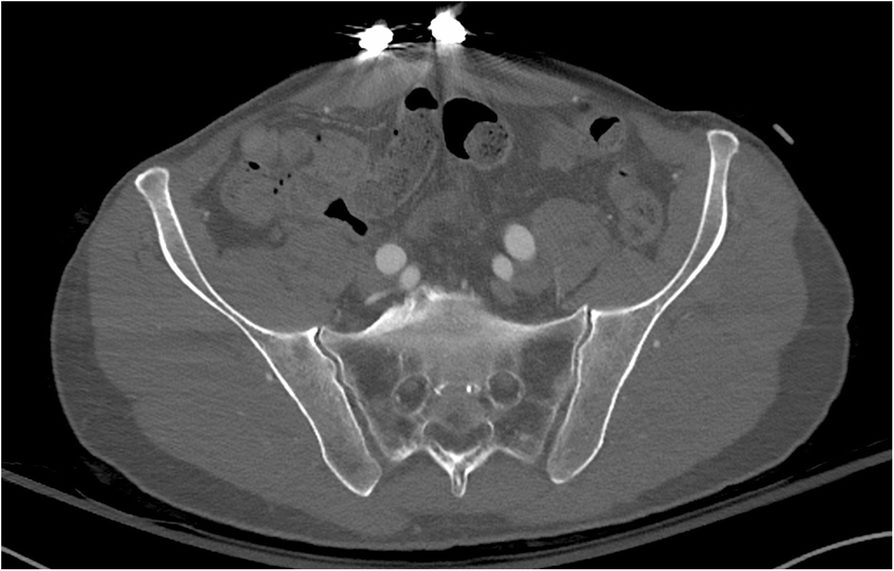
A correctly applied binder reduces the fracture. The CT then images a reduced pelvis — and a ligamentous open-book injury, reduced, can look normal.
Binder on · CT
Binder off · X-ray
The same patient, a short time apart.Binder on: trauma CT with the binder in situ, showing normal sacroiliac joints. Binder off: plain film after the binder was removed, showing pubic symphysis diastasis (white arrow) and left sacroiliac disruption (black arrow) — an open-book injury that needed surgical stabilisation. A 49-year-old after a high-speed motorcycle crash, whose persisting symphyseal pain prompted the second image.Jamme S, Poletti A, Gamulin A, et al. False negative computed tomography scan due to pelvic binder in a patient with pelvic disruption: a case report and review of the literature. J Med Case Rep 2018;12:271. Figs 3 and 5, CC BY 4.0. Placed side by side and labelled; images otherwise unaltered.
This is not one unlucky case. In 43 patients with unstable ring injuries who had an X-ray before the binder went on, then CT with it on, the pre-binder X-ray was diagnostic in 69.4% of anteroposterior-compression and vertical-shear injuries, against 50% for CT with the binder. Swartz 2016 In a tertiary pelvic unit, binder-off films found unexpected unstable injuries in 4 of 54 patients (7%) that the binder-on CT had not shown. Fagg 2018 Even without a binder, the symphyseal gap measured smaller on CT than on the plain film in 70 of 72 patients, by 6.6 mm on average. Gibson 2016
This is not an instruction to take the binder off to get a better picture. Removing a binder from a mechanically unstable, recently bleeding pelvis can restart the bleed. NICE asks you to agree with a pelvic surgeon how an unstable fracture will be managed before the binder comes off. NG37 1.2.18 The lesson for the ED is narrower: a normal binder-on CT does not, by itself, establish “no pelvic fracture” — the NICE trigger for early removal. NG37 1.2.17 Hand it over as “CT with binder in situ”. If the mechanism was high-energy, there is ongoing pelvic pain, or the patient cannot be examined, a senior-led binder-off AP film is the usual next step before the pelvis is called normal; do not discharge or stop worrying on the strength of the CT alone. Fagg 2018Jamme 2018
Two more things the CT cannot promise
No blush is not no bleeding. CT is 98% accurate for a contrast blush, but “an absence of blush in contrast CT does not always exclude an active pelvic bleeding”; a pelvic haematoma of 500 cm³ or more should raise suspicion of an arterial injury even without one. WSES 2017 p.8
A negative FAST excludes nothing in the retroperitoneum.NG39 1.5.30 Pelvic bleeding is retroperitoneal; FAST looks for free intraperitoneal fluid.
Chapter 6
The urethra, the bladder and the rectum
The injuries next door, and the catheter that makes one of them worse.
Honesty tier. NICE NG37 and NG39 say nothing about urethral catheterisation or rectal examination in pelvic fracture. Everything in this chapter is from WSES 2017, which in turn cites ATLS and the WHO. Your trust’s urology and major trauma network guidance governs.
The pelvic ring surrounds the bladder, urethra, rectum and vagina, and a high-energy fracture can tear any of them. WSES quotes lower urinary tract and urethral injury in 7–25% of pelvic ring fractures, with about 23% of urethral injuries missed at first assessment, and ano-rectal injury in 18–64%. WSES 2017 pp.3, 8
Why the catheter waits
The male posterior urethra is tethered where it passes through the pelvic floor, and a displaced pelvic fracture can partially tear it. Anatomy Passing a catheter blindly through a partial tear can complete it. WSES: insertion “without other previous investigations in patients with a pelvic injury could be associated with severe complications: either acute like complete transection of the urethra, or chronic like stricture formation, impotence and urinary incontinence”. WSES 2017 p.8
The warning signs are blood at the urethral meatus, a perineal or scrotal haematoma, a high-riding or impalpable prostate, and an unstable pelvic fracture. WSES text advises a urethrogram when these local signs or a disrupted pelvis on X-ray are found; its graded recommendation is a retrograde urethrogram and/or urethrocystogram with contrast CT when there is a perineal haematoma with pelvic disruption on X-ray, WSES 1B and a suprapubic catheter if the urethrogram is positive or suspicion is high. WSES 2017 pp.6, 8 It also notes the sequencing is disputed — a urethrogram before the trauma CT can make the CT harder to read.
The rectum and the open fracture
If a rectal injury is strongly suspected, perineal and digital rectal examination are mandatory WSES 1B, with proctoscopy if positive. WSES 1C Blood on the glove or in the vagina turns a closed fracture into an open one, with the infection risk that brings. The first priority is still haemodynamic and pelvic stabilisation. WSES 2017 p.3
Chapter 7
The older patient: low energy, normal observations, still bleeding
The pathway is written for high-energy trauma. The patient who fell from standing did not read it.
NICE’s binder and CT-first-line recommendations are written for blunt high-energy trauma, and most older people with pelvic fractures fell from standing. That does not make them safe. WSES: in older people “even a minor trauma could cause major pelvic fractures or bleedings due to the bones fragility and the decrease in function of regulation systems as the vasospasm”. WSES 2017 p.9 Their fractures are more often lateral-compression and undisplaced, so a binder has less to close.
The more unsettling finding is how normal they can look. In a prospective single-centre series of blunt trauma patients with major pelvic fractures who were offered angiography regardless of haemodynamics, 16 of 17 patients aged 60 or over (94%) had bleeding requiring embolisation, against 39 of 75 younger patients (52%) — and two thirds of the older group had normal vital signs on admission. Kimbrell 2004 WSES accordingly suggests considering angiography in older patients with pelvic fractures regardless of haemodynamic status. WSES 2C
Why this does not mean every pubic ramus fracture needs an angiogram
Kimbrell’s patients had major pelvic fractures or significant haematomas on CT, at a centre that practised angiography liberally. It is a warning that normal observations do not exclude bleeding in this group — not a licence to extrapolate to every fall. Anticoagulation, beta-blockade and lower physiological reserve make it worse: see the silver trauma module for the lower thresholds and the reversal module for the anticoagulant.
Pitfalls
Ten ways pelvic trauma goes wrong in the ED
Each of these happens in good departments, to good clinicians, usually under time pressure.
01The binder is round the waist
Why it happens
“Hips” means iliac crests to most people, and a binder applied pre-hospital is rarely re-checked.
Instead
Check every binder on arrival — over the greater trochanters, legs together and internally rotated. Around half are placed wrongly. Bonner 2011Naseem 2018
02Springing the pelvis to “check”
Why it happens
It is taught as part of the secondary survey and feels like doing something.
Instead
Ask and palpate gently. Springing misses three quarters of unstable fractures and can dislodge clot. Shlamovitz 2009
03Believing the binder-on CT
Why it happens
“CT: no pelvic fracture” is a strong sentence, and the report may not mention the binder.
Instead
Treat it as imaging of a reduced pelvis. Hand over “CT with binder in situ”, and get senior-led binder-off imaging before calling the pelvis normal if the mechanism or examination is concerning. Fagg 2018
04Calling a transient responder “stable”
Why it happens
The blood pressure came up after the first units, and that is the number that was written down.
Instead
Judge the response over time. NICE activates the major haemorrhage protocol on physiology and response to volume, not a single reading. NG39 1.5.13–1.5.14
05Taking the unstable patient to CT
Why it happens
The scanner is next door and the diagnosis feels incomplete.
Instead
Minimum imaging to direct intervention, then theatre or IR. NG39 1.5.29
06A blind catheter past blood at the meatus
Why it happens
Urine output is on the checklist, and the catheter pack is already open.
Instead
Stop and look for the warning signs first; involve urology. WSES 2017 (not NICE)
07Assuming the angiogram fixes it
Why it happens
“Bleeding” suggests “vessel”, and embolisation feels definitive.
Instead
Remember 80–90% is venous and bony. Persistent instability after angiography should prompt consideration of packing. WSES 2A
08Crystalloid to chase a blood pressure
Why it happens
Fluid is quick and blood takes a phone call.
Instead
No crystalloid in active bleeding in hospital; restrictive, blood-based resuscitation. NG39 1.5.18, 1.5.23
09Log rolling before the pelvis is imaged
Why it happens
The back needs examining and the sheet needs changing.
Instead
Only to clear the airway, or for suspected occult penetrating injury in an unstable patient. NG37 1.2.19
10Forgetting the binder is on
Why it happens
It works, the patient improves, and ownership passes between three teams.
Instead
Document the time it went on. Remove within 24 hours, after agreeing the plan with a pelvic surgeon. NG37 1.2.17–1.2.18
Red herrings
Seven findings that look reassuring and are not
None of these is wrong information. Each answers a different question from the one you are asking.
Looks reassuring
“The blood pressure is normal.”
Young patients hold their pressure until they cannot, and in one angiography series 16 of 17 older patients with major pelvic fractures were bleeding — while two thirds of that older group had normal vital signs on arrival. Kimbrell 2004
Looks reassuring
“The pelvis felt stable.”
An unstable ring was felt in only 26% of mechanically unstable fractures. A negative spring test is close to meaningless. Shlamovitz 2009
Looks reassuring
“CT: no pelvic fracture.”
If the binder was on, the CT imaged a reduced ring. It describes the scan, not the injury. Jamme 2018Swartz 2016
Looks reassuring
“FAST negative.”
FAST does not see the retroperitoneum, which is where pelvic blood goes. NG39 1.5.30
Looks reassuring
“No contrast blush.”
Absence of a blush does not always exclude active bleeding; a large haematoma should keep arterial injury in mind. WSES 2017 p.8
Looks reassuring
“The haemoglobin is fine.”
Haemoglobin and haematocrit are not sensitive early markers of haemorrhagic shock. WSES grades lactate and base deficit as sensitive markers WSES 1B — most useful as a trend, and a normal value does not exclude bleeding. WSES 2017 pp.5–6
Looks reassuring
“It’s only a low-energy fall / a minor fracture pattern.”
Fracture grade correlates poorly with the need for haemostasis, and in older people minor trauma can cause major bleeding. WSES 2017 pp.4, 9
The case, revisited
What was wrong with the motorcyclist
Heart rate 118 with a normal blood pressure is compensation, not stability. Watch the response over time, not the first reading. (Pitfall 04)
The binder at the iliac crests is too high to close the ring. Move it down to the trochanters. (Chapter 3)
“Feels stable” on springing tells you almost nothing, and the manoeuvre itself risked the clot. (Chapter 4)
Blood at the meatus with a catheter pack open — stop; this is a possible urethral injury. (Chapter 6)
“No pelvic fracture” on a CT done with the binder on does not clear an open-book injury. The imaging trap is the Jamme case. Get senior-led binder-off imaging before calling the pelvis normal. (Chapter 5)
And the pattern behind all five: every one of those findings was true. The failure is in what each was taken to mean.
How much of pelvic trauma care rests on trials? Very little. The World Society of Emergency Surgery searched the literature from 1980 to 2015 for its 2017 guideline and reported: “No randomized controlled trials were found.”WSES 2017 p.2 What follows is the evidence behind the main decisions, what each study actually showed, and how far it can carry the weight put on it.
The strength column is this module’s appraisal, not a published grade.
Question
Best evidence
Design
Strength
Does a binder help?
Croce 2007; Bakhshayesh 2016
Retrospective cohort; narrative systematic review
Low — surrogate outcomes, no mortality benefit shown
Where should it sit?
Bonner 2011; Naseem 2018
Retrospective radiographic series
Low — radiological reduction only
Can you examine for instability?
Shlamovitz 2009
Retrospective chart review
Low–moderate — consistent with teaching
Can you trust the binder-on CT?
Swartz 2016; Gibson 2016; Fagg 2018; Jamme 2018
Retrospective series; case report
Low, but consistent in direction
Packing or angiography?
Osborn 2009; Li 2016
Matched retrospective; quasi-randomised (56)
Low — tiny, underpowered for death
Older patients
Kimbrell 2004
Prospective observational, single centre
Low
Blood ratio and TXA
PROPPR 2015; CRASH-2 2010
Large RCTs in trauma haemorrhage
CRASH-2: high for all-cause mortality. PROPPR: moderate — primary outcomes negative, and it compared 1:1:1 with 1:1:2, not NG39’s 1:1. Both indirect for the pelvis
REBOA
UK-REBOA 2023
Bayesian RCT, 90 patients
Moderate — small, but randomised, and it points to harm
Does a binder help?
Croce 2007 — pelvic orthotic device versus external fixation
Retrospective cohortn = 18610 years
Of 3,359 patients admitted with pelvic fractures, 186 had severe unstable injuries: 93 managed with emergent external pelvic fixation, 93 with a pelvic orthotic device (a binder). Croce 2007
Transfusion, first 24 h
4.9 vs 17.1 units (binder vs external fixation), p < 0.0001
Transfusion, first 48 h
6.0 vs 18.6 units, p < 0.0001
Hospital stay
16.5 vs 24.4 days, p < 0.03
Mortality
26% vs 37%, p = 0.11 — not statistically significant
A systematic review nine years later found evidence that external compression reduces disrupted pelvic rings, some reported complications, and concluded that the haemorrhagic source and “physiological effectiveness of PCCDs needs to be addressed in future studies.” Bakhshayesh 2016
So what. The binder reliably reduces the ring and, in a retrospective comparison with emergent external fixation, was associated with more than two-thirds less transfusion — across a change in practice, so era effects cannot be excluded. It has not been shown to save lives. Note the abstract’s own conclusion says the device “has reduced mortality” — its own results section says the difference was not significant. Read the results, not the conclusion.
Where should it sit?
Bonner 2011 and Naseem 2018 — binder position on imaging
Retrospective radiographicMilitary hospital · UK MTC
Bonner — binders at trochanteric level
83 of 167 radiographs (50%); high in 65 (39%) Bonner 2011
Bonner — open-book subgroup (n = 17)
Mean symphyseal gap 2.8 times greater with a high binder (mean difference 22 mm), p < 0.01
30 of 67 patients with a pelvic ring injury, 6 of them unstable
So what. The outcome is radiological gap, in 17 patients, not bleeding or survival. But the mechanism is plausible, the error is common in two very different settings, and correcting it costs nothing. This is the highest-yield, lowest-risk intervention on the page.
Can you examine for instability?
Shlamovitz 2009 — the pelvic ring stability examination
Sensitivity 26% (95% CI 15–43), specificity 99.9%, for a mechanically unstable fracture
Pelvic deformity
Sensitivity 55% (38–70), specificity 97%
Pain or tenderness, GCS >13
Sensitivity 100% (85–100), specificity 93%
So what. Examination can rule a fracture in, not out. The reassuring 100% for pain in alert patients rests on a retrospective review with 34 unstable fractures, and the authors themselves call for a prospective study. It supports “ask and palpate” in alert patients; it does not support clearing a pelvis on examination in anyone else.
Swartz — 43 unstable injuries, stress examination under anaesthetic as reference
APC / vertical shear: pre-binder X-ray diagnostic in 69.4%, CT with binder 50%; together 83.3%. Lateral compression largely unaffected. Swartz 2016
Fagg — tertiary pelvic unit, 54 patients with binder-off imaging
4 (7%) unexpected unstable injuries not identified on CT in binder Fagg 2018
Gibson — 72 patients, no binder
Symphyseal diastasis smaller on CT than on radiograph in 70 of 72, by 6.6 mm on average; 14 fell below 25 mm, a traditional operative cut-off Gibson 2016
So what. Three retrospective series from three centres, the same direction: CT under-reads anterior-posterior ring disruption — with a binder on (Swartz, Fagg), and Gibson shows diastasis narrowing on supine CT even without one. All three studied patients who went on to surgery or examination under anaesthesia, so the proportion missed in an unselected ED population is unknown — but the direction of error is consistent, and it is the dangerous one.
Packing or angiography?
Osborn 2009 and Li 2016 — the two head-to-head comparisons on this page
Matched retrospective (40)Quasi-randomised (56)
Osborn — time to intervention
Packing 45 min vs angiography 130 min (medians) Osborn 2009
Osborn — deaths
Packing 4 (none from uncontrolled haemorrhage) vs angiography 6 (2 from acute haemorrhage)
Li — time to intervention
Packing 77 min vs angiography 102 min, p < 0.01 Li 2016
Li — crossover
9 of 27 angiography patients needed packing; 6 of 29 packing patients needed angiography
Li — deaths
Packing 4 (none from exsanguination) vs angiography 5 (2 from exsanguination), p = 0.449
Li’s “quasi-randomisation” allocated by time of admission, and the packing group was more severely injured (ISS 48 vs 43). Neither study could detect a difference in death.
So what. Packing is faster; neither has been shown to be safer. The high crossover rates are the real lesson — they are complementary tools for a bleed that is usually both venous and arterial, which is how WSES frames them and why NICE chooses between them by whether the abdomen needs opening. NG37 1.2.16
Older patients
Kimbrell 2004 — angiographic embolisation in patients aged 60 and over
Prospective observationaln = 92 angiograms · single centre
Bleeding requiring embolisation, age ≥60
16 of 17 (94%)
Bleeding requiring embolisation, under 60
39 of 75 (52%), p < .001
Older patients with normal vital signs on admission
Two thirds
So what. Seventeen patients, at a centre that offered angiography to anyone with a major fracture or significant haematoma. It cannot tell you the bleeding rate in older people with pelvic fractures generally. What it does show is that normal observations do not exclude it, which is the red herring that matters.
Blood and tranexamic acid
PROPPR 2015 and CRASH-2 2010 — large trials relevant to NG39’s resuscitation recommendations
RCTRCTnot pelvis-specific
PROPPR — 680 patients, 1:1:1 vs 1:1:2 plasma:platelets:red cells
Mortality at 24 h 12.7% vs 17.0% (P = .12) and 30 days 22.4% vs 26.1% (P = .26) — primary outcomes not significant. Death from exsanguination 9.2% vs 14.6% (P = .03); haemostasis 86% vs 78%. Holcomb 2015
CRASH-2 — 20,211 adults, TXA vs placebo within 8 h
All-cause death 14.5% vs 16.0%, RR 0.91 (0.85–0.97); death from bleeding 4.9% vs 5.7%, RR 0.85. CRASH-2 2010
So what. The best evidence in pelvic trauma is not about the pelvis. These trials enrolled bleeding trauma patients of every kind, and the pelvic subgroup is not reported in either abstract. Applying them to pelvic haemorrhage is reasonable — it is the same physiology — but it is extrapolation. NICE’s 3-hour TXA limit, and why the timing matters, is set out in the tranexamic acid monograph.
REBOA
UK-REBOA 2023 — a guideline overtaken by a trial
Bayesian RCTn = 90 · 16 UK major trauma centres · age 16+
In 2017, WSES suggested that in unstable patients with suspected pelvic bleeding, zone III REBOA “should be considered as a bridge to definitive treatment” WSES 2B, while acknowledging the lack of high-quality evidence. WSES 2017 p.9 Six years later the UK tested REBOA in the emergency department in trauma patients with exsanguinating haemorrhage. Jansen 2023
90-day mortality
54% (25 of 46) REBOA + standard care vs 42% (18 of 43) standard care
Odds ratio
1.58 (95% credible interval 0.72–3.52); posterior probability of increased odds of death 86.9%
Deaths from bleeding
8 of 25 (32%) vs 3 of 18 (17%), most within 24 h
So what. Ninety patients is small, and they were not selected for pelvic bleeding. But it is randomised, it was run in UK major trauma centres, and the authors conclude it “does not reduce, and may increase, mortality”. The 2017 suggestion predates it. When a guideline and a later trial disagree, check the dates before you check the grades.
Critical appraisal
Reading the pelvic trauma evidence honestly
Grades can outrun evidence. WSES found no RCTs, yet grades the binder recommendation 1A. Its own GRADE table allows 1A for “overwhelming evidence from observational studies” — but the observational evidence is about transfusion and ring reduction, and the same guideline says the binder alone “doesn’t seem to reduce mortality”. A letter grade is a summary of a judgement, not a measurement.
Surrogates dominate. Symphyseal gap, units transfused and time to procedure are all measured well; death almost never is, because the studies are far too small. A consistent effect on a surrogate is worth acting on when the intervention is cheap and safe (a correctly placed binder). It is not enough when the intervention is invasive (REBOA).
Selection hides in the denominator. The binder-on CT studies enrolled patients who went on to surgery or examination under anaesthesia; Kimbrell enrolled patients sent for angiography. Each tells you the direction of a risk, not its size in your unselected resus room.
The strongest trials are indirect. PROPPR and CRASH-2 are large and well conducted, but neither was designed around pelvic haemorrhage. That is a reasonable extrapolation, and it should be named as one.
Conclusions are not results. Croce’s abstract concludes the binder reduced mortality; its own results give p = 0.11. Read the results, not the conclusion.
Newer can beat graded. WSES 2017 suggested considering REBOA; UK-REBOA 2023 found a probable increase in death. Currency matters as much as grade.
NICE 2016 is still the UK spine. NG37 and NG39 were published in 2016, before several of the studies above, and the decision tool follows them verbatim. Where this chapter goes beyond NICE, it says so, tier by tier.
The balanced position
Pelvic trauma care is built on physiology, anatomy and small observational series, with large trials borrowed from trauma haemorrhage as a whole. Do the cheap, safe, mechanistically sound things well — bind early and over the trochanters, resuscitate with blood, give TXA early, avoid springing and log rolling, and do not believe a CT taken through a binder. Be sceptical of anything invasive whose benefit rests on surrogates, and let the physiology, not the fracture pattern, decide the route to haemorrhage control.
About this module
What this is, and what it is not
The Decision tool implements NICE NG37 and NG39 and quotes them verbatim. The Teaching and Evidence tabs are different in kind: they are the author’s synthesis of a published guideline (WSES 2017) and primary studies, written to explain the tool, not to extend it. Nothing in them changes what the tool tells you to do. Where they go beyond NICE, the source is named and tagged.
Teaching and Evidence were added in September 2026 and have had no clinical review by anyone other than their author. The review banner at the top of the page applies to them in full.
What this module deliberately does not do
It does not grade the fracture. Young–Burgess and Tile are radiological classifications made after the CT; the ED decisions above do not need them. They are in the classifications tool.
It is not a dosing reference. NG37 and NG39 give no doses for TXA, morphine or reversal. The tool mentions the widely used CRASH-2 TXA regimen, labelled as non-NICE; for everything else use the drug and paediatric tools and your local protocol.
It does not decide the whole major haemorrhage protocol. It points to the physiological trigger NICE names; your trust’s MHP is the operational document.
It does not cover open-book versus lateral-compression management, or open pelvic fractures with perineal wounds, as surgical problems. Those are decisions for the pelvic surgeon at the MTC.
It does not extend beyond blunt trauma. NICE’s pelvic binder and CT-first-line recommendations are written for blunt high-energy mechanisms.
Sources in full — decision tool
NICE NG37. Fractures (complex): assessment and management. Published 17 February 2016 (recommendation 1.1.10 amended 2017). The Recommendations chapter was parsed for this module; the pelvic recommendations used here are 1.1.7, 1.1.13 and 1.2.10–1.2.19.
NICE NG39. Major trauma: assessment and initial management. Published 17 February 2016. The full Recommendations chapter was parsed; the haemorrhage, imaging, heat and pain recommendations used here are in sections 1.5–1.7. Recommendations apply to both children (under 16s) and adults (16 or over) unless otherwise specified.
Every quotation in the Decision tool is verbatim from the recommendation named beside it; quotations in Teaching and Evidence are verbatim from the source cited beside them. The one non-NICE element — where to place the binder — is labelled as such wherever it appears.
References — teaching and evidence
National Institute for Health and Care Excellence. Fractures (complex): assessment and management (NG37). 2016.
National Institute for Health and Care Excellence. Major trauma: assessment and initial management (NG39). 2016.
Coccolini F, Stahel PF, Montori G, et al. Pelvic trauma: WSES classification and guidelines. World J Emerg Surg 2017;12:5. doi:10.1186/s13017-017-0117-6. CC BY 4.0. Full text parsed; page numbers refer to the published PDF.
Bonner TJ, Eardley WG, Newell N, Masouros S, et al. Accurate placement of a pelvic binder improves reduction of unstable fractures of the pelvic ring. J Bone Joint Surg Br 2011;93(11):1524–8. PMID 22058306.
Naseem H, Nesbitt PD, Sprott DC, Clayson A. An assessment of pelvic binder placement at a UK major trauma centre. Ann R Coll Surg Engl 2018;100(2):101–5. PMID 29022794.
Bakhshayesh P, Boutefnouchet T, Tötterman A. Effectiveness of non invasive external pelvic compression: a systematic review of the literature. Scand J Trauma Resusc Emerg Med 2016;24:73. PMID 27193135.
Croce MA, Magnotti LJ, Savage SA, Wood GW, Fabian TC. Emergent pelvic fixation in patients with exsanguinating pelvic fractures. J Am Coll Surg 2007;204(5):935–9. PMID 17481514.
Shlamovitz GZ, Mower WR, Bergman J, et al. How (un)useful is the pelvic ring stability examination in diagnosing mechanically unstable pelvic fractures in blunt trauma patients? J Trauma 2009;66(3):815–20. PMID 19276759.
Swartz J, Vaidya R, Hudson I, Oliphant B, et al. Effect of pelvic binder placement on OTA classification of pelvic ring injuries using computed tomography. Does it mask the injury? J Orthop Trauma 2016;30(6):325–30. PMID 26709813.
Gibson PD, Adams MR, Koury KL, Shaath MK, et al. Inadvertent reduction of symphyseal diastasis during computed tomography. J Orthop Trauma 2016;30(9):474–8. PMID 27218692.
Fagg JAC, Acharya MR, Chesser TJS, Ward AJ. The value of ‘binder-off’ imaging to identify occult and unexpected pelvic ring injuries. Injury 2018;49(2):284–9. PMID 29198375.
Jamme S, Poletti A, Gamulin A, et al. False negative computed tomography scan due to pelvic binder in a patient with pelvic disruption: a case report and review of the literature. J Med Case Rep 2018;12:271. doi:10.1186/s13256-018-1808-7. CC BY 4.0.
Osborn PM, Smith WR, Moore EE, et al. Direct retroperitoneal pelvic packing versus pelvic angiography: a comparison of two management protocols for haemodynamically unstable pelvic fractures. Injury 2009;40(1):54–60. PMID 19041967.
Li Q, Dong J, Yang Y, et al. Retroperitoneal packing or angioembolization for haemorrhage control of pelvic fractures — quasi-randomized clinical trial of 56 haemodynamically unstable patients with Injury Severity Score ≥33. Injury 2016;47(2):395–401. PMID 26508436.
Kimbrell BJ, Velmahos GC, Chan LS, Demetriades D. Angiographic embolization for pelvic fractures in older patients. Arch Surg 2004;139(7):728–32. PMID 15249404.
Holcomb JB, Tilley BC, Baraniuk S, et al. Transfusion of plasma, platelets, and red blood cells in a 1:1:1 vs a 1:1:2 ratio and mortality in patients with severe trauma: the PROPPR randomized clinical trial. JAMA 2015;313(5):471–82. PMID 25647203.
CRASH-2 trial collaborators. Effects of tranexamic acid on death, vascular occlusive events, and blood transfusion in trauma patients with significant haemorrhage (CRASH-2): a randomised, placebo-controlled trial. Lancet 2010;376(9734):23–32. PMID 20554319.
Jansen JO, Hudson J, Cochran C, et al. Emergency department resuscitative endovascular balloon occlusion of the aorta in trauma patients with exsanguinating hemorrhage: the UK-REBOA randomized clinical trial. JAMA 2023;330(19):1862–71. PMID 37824132.
WSES 2017 was read in full. For Jamme 2018 the abstract and figure captions were used. For every other study, the figures on this page are taken from the published abstract, retrieved from PubMed. Where a figure matters and the abstract did not give it, the page does not state it.
Image credits and licences
Posterior ligaments of the pelvis — Gray’s Anatomy of the Human Body (1918), Fig. 320, H. V. Carter. Public domain.