The decision tool tells you what NG41 says to do. This chapter is about why — why the neck and the back are cleared by two different rules, why the order of the Canadian C-spine questions is not negotiable, what a collar actually costs, and where NG41 stops and hands the decision to someone else. It is meant to be read before the shift, not during it.
A 72-year-old is brought in after tripping on a kerb and striking her forehead. GCS 15, moving all four limbs, complaining that her hands feel “clumsy” and tingly. She has no midline neck tenderness and says she walked into the ambulance. A junior colleague notes she is ambulatory with no midline tenderness — two Canadian C-spine low-risk factors — assumes her low-energy trip counts as a third, and asks her to rotate her neck to clear it. She turns her head 45° each way without much pain and he reaches for the discharge letter.
By the end of this chapter you should be able to name at least four things wrong with that plan. They are listed at the bottom.
Why we do what we do, in one table
Every step in the decision tool, and the reason it is there.
| What we do | Why | Basis |
|---|---|---|
| Immobilise first, clear second | The clearance rules only work in a patient you can actually examine. If any 1.1.3 factor is present — or you cannot do the assessment — immobilisation stays, and no rule below overrides that. | NG41 1.1.3, 1.4.4 |
| Clear the neck and the back separately | They are two different lists with different mechanisms, thresholds and imaging routes. Clearing one says nothing about the other. | NG41 1.1.5, 1.1.7 |
| Neck: high-risk factors before the rotation test | The rotation test is only safe once there is a low-risk factor and no high-risk factor. Testing rotation in a high-risk neck is the error the rule is built to prevent. | NG41 1.1.5 Stiell 2001 |
| Neck imaging in adults is CT | CT is more sensitive than plain films for the injuries that matter; NG41 makes it the adult study when imaging is indicated. | NG41 1.5.6 |
| Children get MRI or X-ray, not routine whole-body CT | To spare the developing thyroid and marrow from CT dose; the paediatric pathway is deliberately different. | NG41 1.5.2–1.5.4, 1.5.15 |
| Back: dangerous fall is 3 m, not 1 m | The thoracolumbar list has its own thresholds; the number that clears a neck does not clear a back. | NG41 1.1.7 |
| Any neurology that could be cord → MRI after CT | CT shows bone; MRI shows cord, ligament and disc, “regardless of whether or not the abnormality is evident on CT”. | NG41 1.5.7 |
| Suspected cord: call, and the 4-hour call | The specialist surgeon contacts the linked spinal cord injury centre consultant within 4 hours of diagnosis to establish a partnership of care. | NG41 1.6.1–1.6.3 |
| No neuroprotective steroids | The one “positive” steroid result was a post-hoc subgroup that never replicated; NG41 says do not give them. | NG41 1.7.3 NASCIS II |
| Adults 18+: MAP 75–80 to 90–95, surgery within 24 h | Perfuse the injured cord and decompress it early — offered as an option, on weak-to-moderate evidence, and not for under-18s. | AO Spine 2024 STASCIS |
| In trauma, hypotension is bleeding until proven otherwise | Neurogenic shock is a diagnosis of exclusion in a trauma patient; assuming it first kills people who are exsanguinating. | AO Spine 2024 standard teaching |
Two rules sharing one guideline
NG41 clears the neck and the back by different logic. Treating them as one decision is the commonest structural mistake.
NG41 is not a single spinal-clearance rule. It contains the Canadian C-spine rule for the cervical spine (1.1.5) and a separate list of factors for the thoracic and lumbosacral spine (1.1.7). They were built from different evidence, they have different thresholds, and they hand you to different imaging. A cleared neck tells you nothing about the back, and vice versa — which is why the decision tool reports the two regions in separate boxes and never lets one clear the other.
Both sit downstream of a gate that comes first: recommendation 1.1.3. If the patient has a distracting injury, is intoxicated, is confused or has a reduced level of consciousness, is neurologically abnormal, has spinal pain or has past spinal problems — or if you simply cannot do the assessment — then “carry out or maintain full in-line spinal immobilisation.” NG41 1.4.4 No clearance rule can be used to talk yourself out of immobilising a patient you cannot examine. The rules in steps 3 and 4 decide imaging; they do not decide whether the collar stays on when a 1.1.3 factor is present.
The reassuring-sounding answer at a gate should never discard a sick patient’s findings. On this hub the same bug has appeared repeatedly — a “cleared” branch that quietly dropped altered consciousness, or neurology. Here, any neurological symptom or sign is itself a 1.1.3 factor: it keeps immobilisation on and makes the rotation test meaningless.
The neck rule, and why the order is fixed
High-risk factor first. Low-risk factor second. Rotation last — and only if the first two allow it.
The Canadian C-spine rule asks three questions in a strict order. One: is there a high-risk factor that mandates imaging — age 65 or over, a dangerous mechanism, or paraesthesia in the limbs? If yes, image; do not test rotation. Two: is there a low-risk factor that makes it safe to assess movement — a simple rear-end collision, comfortable sitting, ambulatory since injury, delayed onset of neck pain, or absence of midline tenderness? A low-risk factor is what permits the rotation test; it does not clear anything on its own. Three: only then, can the patient actively rotate their neck 45° to the left and right?
The order is the whole safety mechanism. NG41 puts it plainly: the neck’s range of movement “can only be assessed safely if the person is at low risk and there are no high-risk factors.” Ask someone aged 65 with a dangerous mechanism to turn their head and you have done a dangerous test on a high-risk neck. The tool disables the rotation control until the rule allows it, and tells you which condition is blocking it.
Two further NG41 subtleties the tool surfaces rather than smooths over. The rotation test is active — the patient turns their own head; you never rotate it for them. And clearance under 1.4.8 requires the patient to be “pain free” as well as able to rotate — so a patient who turns fully but still has neck pain is not cleared by NG41’s wording, even though 1.4.7 does not mandate imaging for them either. That is a genuine gap; the tool flags it as a senior decision instead of inventing a rule.
The back — a different list, on purpose
The thoracolumbar factors are not the cervical ones with the spine swapped in. The thresholds differ.
The thoracic and lumbosacral list (1.1.7) has a different dangerous-fall height and a different age rule. The dangerous fall for the neck is more than 1 metre or 5 steps; for the back it is more than 3 metres, with landing on the feet or buttocks named specifically because axial load transmits up the column. Age 65 is a high-risk factor for the neck on its own; for the back it counts only when there is thoracic or lumbosacral pain as well.
The list also includes a mobilisation test — sit, stand, step, assess walking — which is done only if nothing else on the list applies, and stopped the moment it produces pain or neurological symptoms. And there is a deliberate ambiguity the tool will not resolve: 1.5.9 makes plain X-ray the first-line thoracolumbar study without neurology, then 1.5.10 says do CT “if the X-ray is abnormal or there are clinical signs or symptoms of a spinal column injury.” NG41 never defines those signs — read literally, the examination findings in 1.1.7 (midline tenderness, deformity, pain on coughing) are such signs, which would make CT first-line for most patients who reach this step. Local practice varies; the tool shows both rules and does not choose.
The collar is not a free intervention
Immobilisation is a treatment with harms, and NG41 says so more clearly than most people remember.
The semi-rigid collar is often applied reflexively and left on for hours. NG41 is explicit that it can do harm: devices “could be counterproductive (for example increasing pain, worsening neurological signs and symptoms)” (1.1.12), and there are patients who should not get a collar at all. If the airway is compromised, or there is a known spinal deformity such as ankylosing spondylitis, do not force a collar — “keep the spine in the person’s current position” (1.1.13). A fused, ankylosed spine fractures with trivial force and a collar can lever it into a dangerous position.
For the agitated or distressed patient — including children — NG41 says “think about letting them find a position where they are comfortable with manual in-line spinal immobilisation” rather than fighting them into a collar (1.1.12). And the longboard is for extrication only: “do not transport people with suspected spinal injury on a longboard or any other extrication device” (1.1.19). In older people the harms of prolonged immobilisation are amplified — see the silver trauma module.
The stepwise technique (manual in-line stabilisation → correctly sized collar → reassess airway → scoop → blocks and tape → vacuum mattress) is NG41 1.1.13–1.1.14. The general principle that “a collar is a treatment, weigh its harms” is standard trauma teaching, presented as such — NG41 gives the specific contraindications, not a blanket warning.
Where NG41 stops and hands the decision away
Two common patients are not cleared by this page at all — and pretending otherwise is the error.
Head injury. If the patient also has a head injury, cervical spine imaging is decided by NICE NG232, not NG41 — and NG41 says so itself at 1.5.5 and 1.5.8. This is a whole-decision handoff, not just a change of modality: the CCR is not applied by this page to a head-injured neck; NG232 section 1.6 governs whether and how to image. When an upstream guideline defers a decision, it defers all of it — so the tool sends these patients to the CT head & C-spine module and keeps only the immobilisation advice.
There is a stale cross-reference worth knowing about: 1.5.5 and 1.5.8 cite “section 1.5 of the NICE guideline on head injury.” NG41 last changed in May 2021; the current head injury guideline NG232 (May 2023) puts the brain in 1.5 and the cervical spine in 1.6. The intent is clearly the C-spine section, and that is where the module points.
Penetrating injury. NG41 contains no recommendation about penetrating trauma — its Canadian C-spine pathway was derived in blunt injury. So the collar and clearance logic here do not apply to a stab or gunshot to the neck; see the penetrating neck module, where “no routine collar” is EAST/PHTLS guidance and explicitly not NICE.
The cord — the first hours
Once neurology suggests the cord, the pathway is about calls, perfusion, timing and what not to give.
Neurology that could be cord is treated as cord until MRI says otherwise. Image: in adults, MRI after CT “regardless of whether or not the abnormality is evident on CT” (1.5.7) — CT shows the bones, MRI shows the cord. Call: the trauma team leader contacts the on-call neurosurgical or spinal surgeon immediately (1.6.1–1.6.2); that surgeon then “should contact the linked spinal cord injury centre consultant within 4 hours of diagnosis to establish a partnership of care” (1.6.3). Document: complete an ASIA chart as soon as possible for anyone over 4, record vital capacity for anyone over 7, and note whether they can cough (1.9.9).
Do not give neuroprotective drugs: not methylprednisolone, nimodipine or naloxone (1.7.3). The apparent case for steroids rests on a single post-hoc subgroup in NASCIS II that never replicated and came at the cost of infection and other harms — see the Evidence tab. And destination: suspected cord injury goes to a major trauma centre irrespective of transfer time unless a life-saving intervention is needed first, never directly to a spinal cord injury centre from scene (1.3.2–1.3.5).
What AO Spine 2024 adds — for adults 18 and over only
Two recommendations from the AO Spine / Praxis guideline, both of which the module confines to 18+ because the guideline lists “SCI in children or adolescents (i.e., those under 18 years of age)” among the conditions it does not cover:
- Blood pressure. “We suggest the augmentation of MAP to at least 75–80 mmHg but not higher than 90–95 mmHg in order to optimize spinal cord perfusion in acute traumatic SCI”, for 3–7 days. Weak recommendation, very low quality evidence The upper bound is new: it is wider and shorter than the older AANS/CNS target of MAP 85–90 mmHg for 7 days. The guideline declines to choose a vasopressor — “the decision should be left to the attending physician.”
- Timing of surgery. “We recommend that early surgery be offered as an option for adult patients with acute SCI regardless of level”, where early means decompression within 24 hours of injury. Strong recommendation, moderate quality evidence No recommendation could be made for “ultra-early” surgery.
Two kinds of shock, and why the order matters
Spinal shock and neurogenic shock are different things, and confusing them is dangerous in a trauma patient.
Spinal shock is a neurological phenomenon: transient areflexia and flaccid paralysis below the level immediately after injury. It mimics a complete injury, so completeness (the AIS grade) cannot be assigned while it lasts — its resolution is marked by the return of the bulbocavernosus reflex. Do not label an injury “complete” in the ED during spinal shock.
Neurogenic shock is a haemodynamic phenomenon: hypotension with bradycardia from loss of sympathetic tone, in injuries at roughly T6 and above. The trap is that it looks like a reason to stop worrying about bleeding. AO Spine is explicit that hypotension after cord injury “may occur from a combination of hypovolemia from concomitant hemorrhage and neurogenic shock.” In a trauma patient, treat hypotension as bleeding until proven otherwise — neurogenic shock is a diagnosis of exclusion. Neither NG41 nor AO Spine defines neurogenic shock or gives diagnostic criteria, so the module does not either.
The neurological examination — dermatomes, myotomes, reflexes
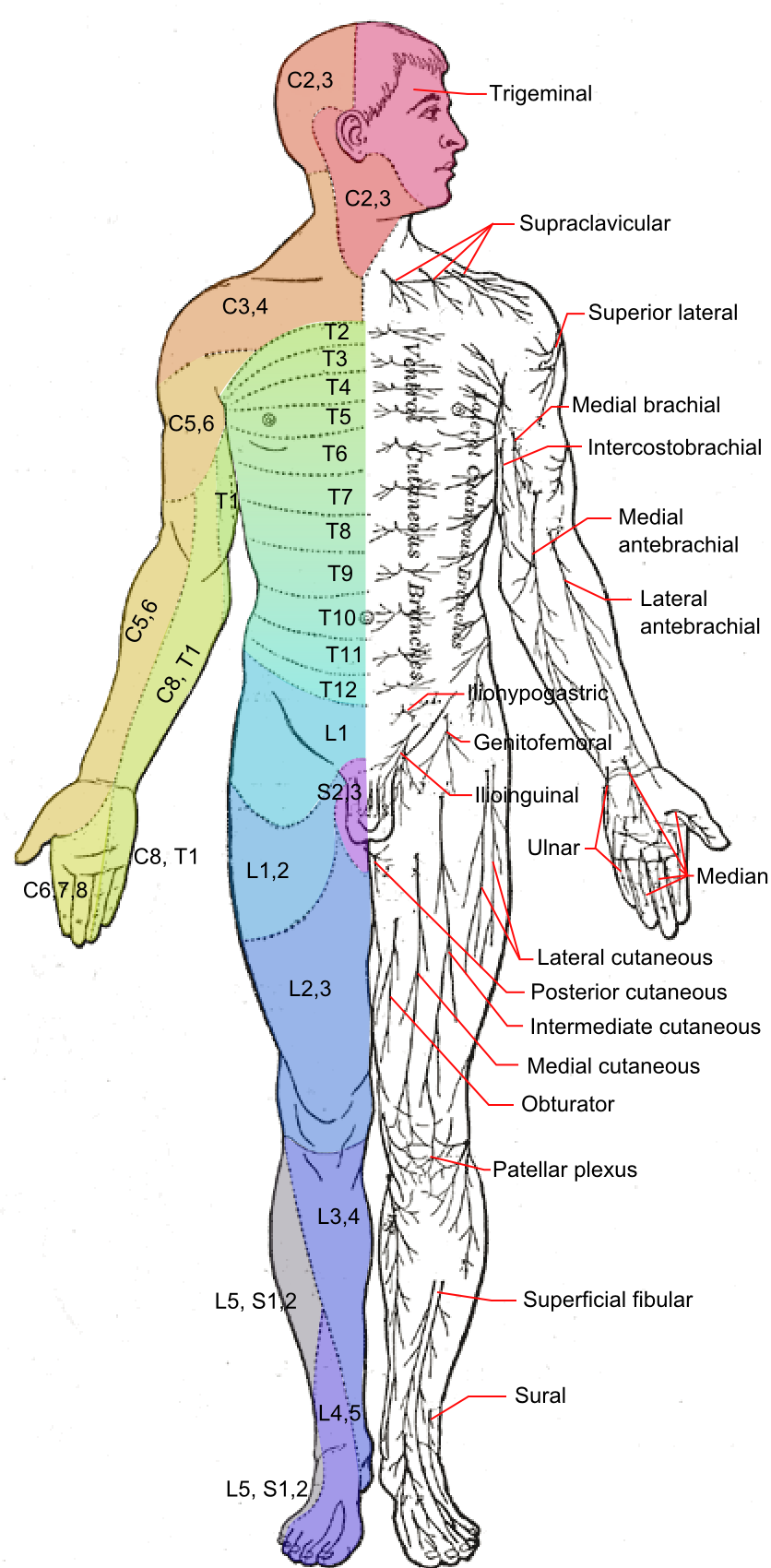
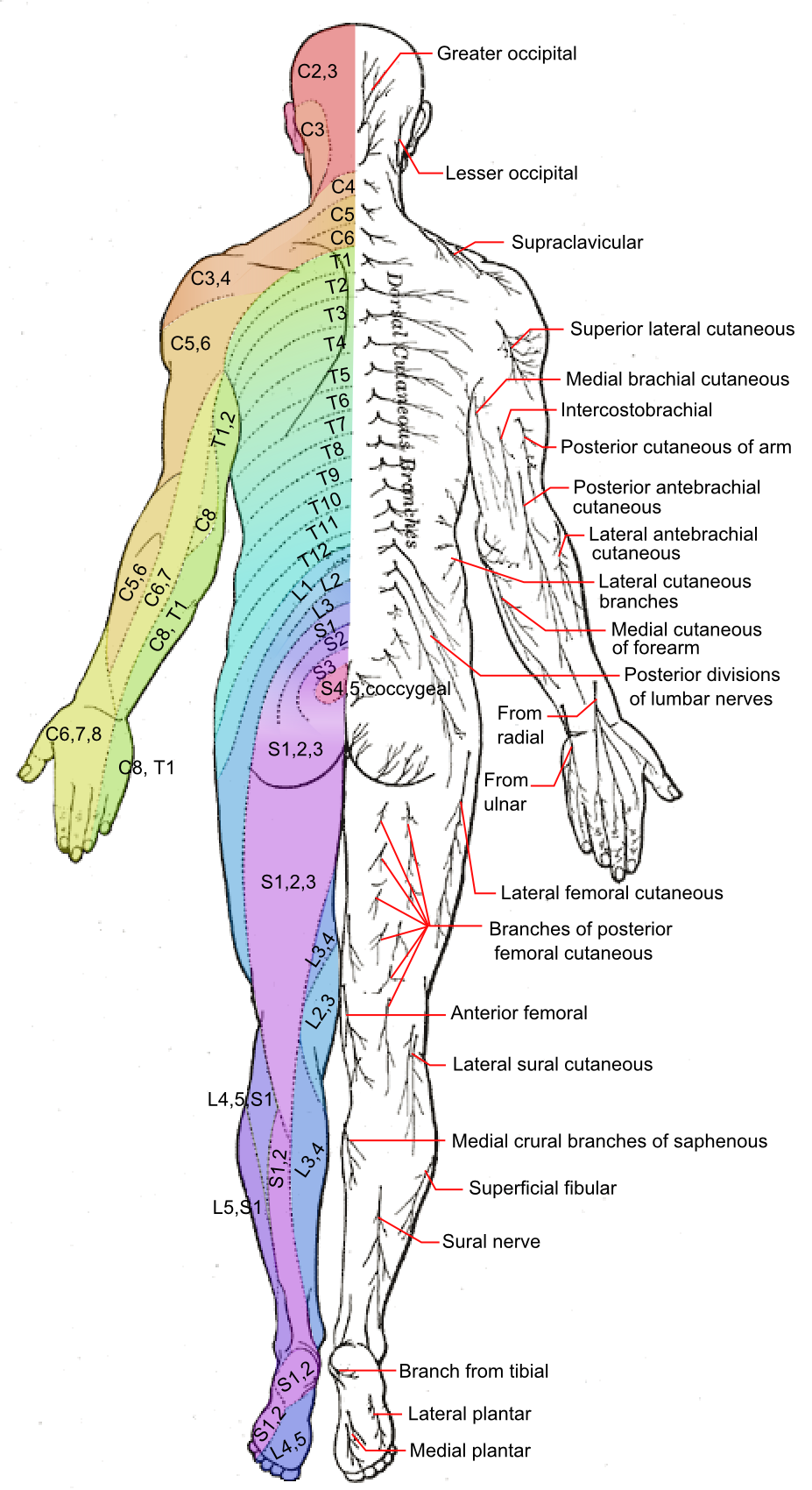
Dermatome maps (dermatome bands on the left half of each figure; named cutaneous nerves on the right). Mikael Häggström, public domain, via Wikimedia Commons (anterior, posterior). Dermatome maps disagree between authors (Keegan & Garrett, Foerster, ISNCSCI) and adjacent dermatomes overlap, so a single root lesion often gives less sensory loss than a map implies. Use the ISNCSCI key points below for classification.
Key sensory points (ISNCSCI)
Each point is tested on both sides for light touch and pin prick, graded 0 (absent), 1 (altered) or 2 (normal). The upper- and lower-limb points are listed in full; the trunk between T2 and L1 is stepped one intercostal space at a time.
| Level | Where to test |
|---|---|
| C2 | Occipital protuberance / just behind the ear |
| C3 | Supraclavicular fossa |
| C4 | Top of the acromioclavicular joint |
| C5 | Lateral (radial) side of the antecubital fossa |
| C6 | Thumb |
| C7 | Middle finger |
| C8 | Little finger |
| T1 | Medial (ulnar) side of the antecubital fossa |
| T4 | Nipple line |
| T6 | Xiphisternum |
| T10 | Umbilicus |
| T12 | Midpoint of the inguinal ligament |
| L2 | Mid-anterior thigh |
| L3 | Medial femoral condyle |
| L4 | Medial malleolus |
| L5 | Dorsum of the foot at the third metatarsophalangeal joint |
| S1 | Lateral heel |
| S2 | Midline of the popliteal fossa |
| S3 | Ischial tuberosity |
| S4–5 | Perianal skin (taken as a single level) |
Key muscles (myotomes)
Ten key muscles per side, graded on the MRC 0–5 scale. There is no ISNCSCI key muscle for T2–L1 or S2 onward, so those motor levels are inferred from the sensory level.
| Root | Key muscle | Action to test |
|---|---|---|
| C5 | Biceps, brachialis | Elbow flexion |
| C6 | Extensor carpi radialis | Wrist extension |
| C7 | Triceps | Elbow extension |
| C8 | Flexor digitorum profundus (middle finger) | Distal finger flexion |
| T1 | Abductor digiti minimi | Little-finger abduction |
| L2 | Iliopsoas | Hip flexion |
| L3 | Quadriceps | Knee extension |
| L4 | Tibialis anterior | Ankle dorsiflexion |
| L5 | Extensor hallucis longus | Great-toe extension |
| S1 | Gastrocnemius, soleus | Ankle plantarflexion |
MRC grade: 0 none · 1 flicker · 2 movement with gravity eliminated · 3 movement against gravity · 4 movement against resistance · 5 normal.
Reflexes
| Reflex | Root(s) | Note |
|---|---|---|
| Biceps | C5–C6 | |
| Supinator (brachioradialis) | C6 | |
| Triceps | C7 | |
| Knee (patellar) | L3–L4 | |
| Ankle (Achilles) | S1–S2 | |
| Plantar | — | Upgoing (Babinski) is an upper motor neurone sign |
| Cremasteric | L1–L2 | Lost in cord lesions above L1 |
| Bulbocavernosus | S3–S4 | Its return marks the end of spinal shock |
| Anal wink | S4–S5 | Sacral reflex arc |
ASIA Impairment Scale (AIS)
| Grade | Definition |
|---|---|
| A — Complete | No motor or sensory function preserved in the sacral segments S4–5 (no sacral sparing). |
| B — Sensory incomplete | Sensation but no motor function preserved below the neurological level, including S4–5, and no motor function more than three levels below the motor level on either side. |
| C — Motor incomplete | Motor function preserved below the neurological level, and more than half of the key muscles below it are weaker than grade 3. |
| D — Motor incomplete | Motor function preserved below the neurological level, and at least half of the key muscles below it are grade 3 or better. |
| E — Normal | Motor and sensory function normal on ISNCSCI testing in a patient who had prior deficits. |
Motor-incomplete status (C or D) requires either voluntary anal contraction, or sacral sensory sparing together with motor sparing more than three levels below the motor level. The neurological level of injury is the most caudal level with normal sensation and antigravity (grade ≥3) power, with normal function above it, on both sides.
Spinal cord syndromes
Incomplete injuries produce recognisable patterns depending on which tracts are damaged. The pattern guides expectation, not the emergency management — every suspected cord injury still follows the pathway above: immobilise, image (CT then MRI in adults), make the calls, and complete the ASIA chart.
Complete injury
- No motor or sensory function below the level, including no sacral sparing (AIS A)
- Must be assessed after spinal shock has resolved
Central cord syndrome
- Arms weaker than legs, and hands worst of all
- Variable sensory loss and bladder dysfunction below the level
Brown-Séquard syndrome
- Ipsilateral motor loss and loss of proprioception/vibration (dorsal column)
- Contralateral loss of pain and temperature (spinothalamic), starting one to two levels below
Anterior cord syndrome
- Loss of motor power and of pain/temperature below the level
- Proprioception, vibration and light touch preserved (dorsal columns spared)
Posterior cord syndrome
- Loss of proprioception and vibration, with a sensory ataxia
- Motor power and pain/temperature preserved
Conus medullaris syndrome
- Early, severe and usually symmetrical bladder, bowel and sexual dysfunction
- Symmetrical saddle anaesthesia; variable, often mild leg weakness
- Mixed upper and lower motor neurone signs (some reflexes may persist)
Cauda equina syndrome
- Asymmetrical flaccid, areflexic leg weakness with radicular pain
- Saddle anaesthesia; urinary retention with overflow, loss of anal tone
Ten ways this goes wrong
Each one has a correct fact behind it that is being applied in the wrong place.
01Testing rotation on a high-risk neck
- The error
- Asking a patient with a high-risk factor — age 65+, dangerous mechanism, or limb paraesthesia — to rotate their neck to “clear” it.
- Why it bites
- The rotation test is only valid once there is a low-risk factor and no high-risk factor. A high-risk factor mandates imaging; the test is never reached (NG41 1.1.5).
02Using the neck’s fall height for the back
- The error
- Applying “more than 1 m or 5 steps” to the thoracolumbar spine, or “more than 3 m” to the neck.
- Why it bites
- The dangerous fall is >1 m / 5 steps for the neck and >3 m for the back. They are different lists with different thresholds (NG41 1.1.5, 1.1.7).
03Rotating the head for the patient
- The error
- Turning the patient’s head to see if it moves 45°.
- Why it bites
- NG41 requires the patient to actively rotate. A passive test can move an unstable neck and means nothing for clearance.
04Clearing a neck that rotates but still hurts
- The error
- Removing immobilisation because the patient turned their head fully, despite ongoing neck pain.
- Why it bites
- 1.4.8 clears only a patient who is also “pain free”. A painful neck that rotates is in a genuine NG41 gap — a senior decision, not an automatic clearance.
05Applying the CCR to a head-injured neck
- The error
- Using this page’s Canadian C-spine logic on a patient who also has a head injury.
- Why it bites
- NG41 1.5.5 / 1.5.8 hand the whole imaging decision to NG232 section 1.6 — whether to image, not just how. Use the CT head & C-spine module.
06Forcing a collar onto a fused spine
- The error
- Applying a semi-rigid collar to a patient with ankylosing spondylitis or another fixed deformity — or when the airway is compromised.
- Why it bites
- NG41 1.1.13 says keep the spine in its current position instead. An ankylosed spine fractures easily and a collar can lever it into a dangerous position.
07Calling hypotension “neurogenic shock” first
- The error
- Attributing low blood pressure to loss of sympathetic tone and easing off the haemorrhage search.
- Why it bites
- In trauma, hypotension is bleeding until proven otherwise. AO Spine notes it “may occur from a combination of hypovolemia from concomitant hemorrhage and neurogenic shock.” Neurogenic shock is a diagnosis of exclusion.
08Grading completeness during spinal shock
- The error
- Recording a “complete” (AIS A) injury on the first ED examination.
- Why it bites
- Spinal shock causes transient areflexia and flaccid paralysis that mimic a complete lesion. Completeness can only be assigned once it resolves (return of the bulbocavernosus reflex).
09Reaching for neuroprotective steroids
- The error
- Giving high-dose methylprednisolone (or nimodipine or naloxone) to a cord-injured patient.
- Why it bites
- NG41 1.7.3 says do not. The “positive” steroid signal was a post-hoc NASCIS II subgroup that never replicated, with real infective harms — see Evidence.
10Giving a 16-year-old the AO Spine targets
- The error
- Setting a MAP of 75–95 mmHg or aiming for 24-hour surgery in a 16- or 17-year-old, because NG41 treats them as adults.
- Why it bites
- AO Spine explicitly excludes everyone under 18. Those numbers are adult recommendations only; paediatric goals belong to the paediatric spinal and major-trauma teams.
Findings that look reassuring and are not
Seven things that feel like permission to stand down, and why they are not.
Ambulation is a Canadian C-spine low-risk factor — it only makes it safe to test rotation. It clears nothing on its own, and it says nothing at all about the thoracolumbar spine.
CT shows bone. Cord, ligament and disc injury can be present with a normal CT — which is exactly why NG41 1.5.7 asks for MRI after CT whenever the neurology could be cord, “regardless of whether or not the abnormality is evident on CT.”
Central cord syndrome — the commonest incomplete pattern — classically follows a low-energy hyperextension fall in an older person with cervical spondylosis. Low energy does not mean low stakes.
Absence of midline cervical tenderness is one low-risk factor and one NEXUS criterion — not a clearance. The rest of the rule still has to be satisfied.
A comfortable story that can hide exsanguination. Treat as haemorrhage until excluded; neurogenic shock is a diagnosis of exclusion in a trauma patient.
Gross power can be preserved while the hands are weak (central cord), or while one side has lost pain and temperature (Brown-Séquard). Record the ISNCSCI key points, not a global impression.
In an unconscious or exposed male, priapism is a recognised sign of cord injury (an NG41 1.1.3 factor). It is a reason to suspect the cord, not an incidental finding.
What was wrong with the plan
The 72-year-old with clumsy, tingling hands after a kerb trip.
- She is high-risk, so the rotation test should never have been offered. Age 65 or over is a Canadian C-spine high-risk factor on its own (NG41 1.1.5) — and so is limb paraesthesia. Two high-risk factors mandate imaging; the low-risk factors are irrelevant once a high-risk one is present.
- Tingling, clumsy hands are neurology, not a soft sign. Altered sensation and hand weakness are 1.1.3 factors and a reason to suspect the cord. This is the picture of central cord syndrome after a low-energy hyperextension fall — arms weaker than legs, hands worst.
- She hit her forehead — this may be an NG232 decision. If there is a head injury, C-spine imaging is decided by NG232 section 1.6, not by the rule the junior used.
- “Clearing” her cleared a criterion, not a patient. Even a fully negative rule is worth only as much as the examination behind it; new or evolving neurology changes the answer.
Correct plan: maintain immobilisation, image (CT, then MRI because the neurology could be cord — 1.5.6, 1.5.7), make the calls, complete the ASIA chart, and treat her as the silver-trauma patient she also is.
How much of spinal clearance and cord care rests on trials? The neck rules are unusually well validated — the Canadian C-spine rule and NEXUS were each derived and tested in tens of thousands of patients. The cord recommendations are the opposite: the blood-pressure target is very-low-quality evidence, and the one famous “positive” steroid result was a post-hoc subgroup that never replicated. What follows is the evidence behind the main decisions, what each study actually showed, and how far it can carry the weight put on it.
Canadian C-spine rule — derivation
Stiell and colleagues evaluated 8924 alert, stable adults (mean age 37, GCS 15) with blunt head or neck trauma across ten Canadian EDs, applying 20 standardised clinical findings before radiography. Stiell 2001
| Important C-spine injuries | 151 of 8924 (1.7%) |
| Sensitivity (cross-validation) | 100% (95% CI 98–100) |
| Specificity | 42.5% (95% CI 40–44) |
| Resulting imaging rate | 58.2% |
The rule is the three-question structure NG41 reproduces: a high-risk factor mandates imaging; a low-risk factor permits assessing range of motion; the patient is then asked to actively rotate 45° each way.
NEXUS low-risk criteria
The NEXUS group tested a five-criterion instrument (no midline tenderness, no focal deficit, normal alertness, no intoxication, no distracting injury) in 34,069 patients undergoing C-spine radiography after blunt trauma at 21 US centres. Hoffman 2000
| C-spine injuries | 818 |
| Missed by the rule | 8 (2 clinically significant, 1 surgical) |
| Sensitivity | 99.0% (95% CI 98.0–99.6) |
| Negative predictive value | 99.8% |
| Specificity | 12.9% |
Canadian C-spine rule vs NEXUS
The same group compared both rules in 8283 alert, stable trauma patients across nine Canadian EDs, interpreted by 394 physicians before radiography. Stiell 2003
| Important C-spine injuries | 169 of 8283 (2.0%) |
| Sensitivity — CCR vs NEXUS | 99.4% vs 90.7% (P<0.001) |
| Specificity — CCR vs NEXUS | 45.1% vs 36.8% (P<0.001) |
| Injuries missed | CCR 1 · NEXUS 16 |
| Radiography rate | 55.9% vs 66.6% |
Early vs late decompression (STASCIS)
A multicentre prospective cohort of 313 adults (16–80) with acute cervical SCI compared decompression before versus after 24 hours. Fehlings 2012
| Early (<24 h) vs late (≥24 h) | 182 (mean 14.2 h) vs 131 (mean 48.3 h) |
| ≥2-grade AIS improvement at 6 months | 19.8% vs 8.8% |
| Odds ratio (unadjusted) | 2.57 (95% CI 1.11–5.97) |
| Adjusted OR | 2.83 (95% CI 1.10–7.28) |
| Complications | 24.2% vs 30.5% (p=0.21) |
Methylprednisolone (NASCIS II)
NASCIS II randomised acute SCI patients to methylprednisolone, naloxone or placebo. Bracken 1990
| Primary (whole-cohort) analysis | Negative — no benefit |
| Post-hoc subgroup treated <8 h | Motor 16.0 vs 11.2 (P=0.03) |
| Naloxone | No benefit |
| Mortality / major morbidity | Similar across groups |
MAP augmentation
AO Spine 2024 suggests augmenting MAP to at least 75–80 but not above 90–95 mmHg for 3–7 days to optimise cord perfusion — a weak recommendation on very low quality evidence, and it declines to name a vasopressor. Tetreault 2024
This deliberately narrows and shortens the older AANS/CNS target (MAP 85–90 mmHg for 7 days), because the higher, longer target was associated with more cardiovascular complications without clear neurological benefit. The honest position is that the target exists to give a floor for cord perfusion, not because a trial has shown a specific number improves outcome.
Reading it critically
- The neck rules are decision instruments, not treatments. They were derived to be highly sensitive and are validated in large cohorts — but sensitivity near 100% is bought with low specificity, so applying them faithfully means imaging most of the people you apply them to. That is the intended trade-off.
- They were derived in alert, stable adults. Both the CCR and NEXUS enrolled alert patients; neither answers what to do in the obtunded or intoxicated patient, where NG41 falls back on immobilisation and imaging. The CCR is explicitly harder to apply in children (NG41 1.1.6).
- The CCR depends on a step that is often skipped. In the head-to-head, physicians did not assess range of motion in 10.2% of patients. A rule is only as good as the examination behind it.
- The cord evidence is weaker than the confidence around it. STASCIS is a cohort, not an RCT; the MAP target is very-low-quality; the steroid “benefit” was post-hoc. AO Spine grades its own recommendations honestly, and so should we.
- Almost none of this was derived in children. The numbers in this tab are adult or unstated-age. The decision tool branches on age; do not carry adult figures across.
The strongest thing on this page is the neck rule: apply the Canadian C-spine rule in order, in the alert stable patient without a head injury, and it will very rarely miss an important injury. The weakest is the cord bundle: perfuse and decompress early because it is biologically reasonable and cautiously supported, but hold those recommendations lightly, keep looking for bleeding, and give no steroids. Where NG41 is silent — the pain-but-rotates neck, the undefined “clinical signs” for thoracolumbar CT, paediatric thoracolumbar neurology — the honest move is to say so and make it a senior decision, not to invent a rule.
References
- NICE NG41. Spinal injury: assessment and initial management. Published 17 February 2016; minor change to 1.5.7 in May 2021. Recommendations chapter parsed in full.
- NICE NG232. Head injury: assessment and early management. May 2023 — section 1.6 (cervical spine) for head-injured patients.
- Tetreault LA, Kwon BK, Evaniew N, Alvi MA, Skelly AC, Fehlings MG. A clinical practice guideline on the timing of surgical decompression and hemodynamic management of acute spinal cord injury… introduction, rationale, and scope. Global Spine J 2024;14(3 Suppl):10S–24S. AO Spine / Praxis Spinal Cord Institute. CC BY 4.0 (PMC10964894).
- Stiell IG, Wells GA, Vandemheen KL, et al. The Canadian C-spine rule for radiography in alert and stable trauma patients. JAMA 2001;286(15):1841–8. Figures from the PubMed abstract.
- Hoffman JR, Mower WR, Wolfson AB, Todd KH, Zucker MI. Validity of a set of clinical criteria to rule out injury to the cervical spine in patients with blunt trauma (NEXUS). N Engl J Med 2000;343(2):94–9. Figures from the PubMed abstract.
- Stiell IG, Clement CM, McKnight RD, et al. The Canadian C-spine rule versus the NEXUS low-risk criteria in patients with trauma. N Engl J Med 2003;349(26):2510–8. Figures from the PubMed abstract.
- Fehlings MG, Vaccaro A, Wilson JR, et al. Early versus delayed decompression for traumatic cervical spinal cord injury: results of the Surgical Timing in Acute Spinal Cord Injury Study (STASCIS). PLoS One 2012;7(2):e32037. Figures from the PubMed abstract.
- Bracken MB, Shepard MJ, Collins WF, et al. A randomized, controlled trial of methylprednisolone or naloxone in the treatment of acute spinal-cord injury (NASCIS II). N Engl J Med 1990;322(20):1405–11. Figures from the PubMed abstract.
The reference
Imaging, by age and region (NG41 1.5)
| Situation | 16 and over | Under 16 |
|---|---|---|
| Neck, with head injury | NICE NG232 section 1.6 — NG41 1.5.5 and 1.5.8 defer to the head injury guideline. See the CT head & C-spine module. | |
| Neck, no head injury | CT if imaging is indicated by the Canadian C-spine rule (1.5.6) | MRI if strong suspicion of cervical cord or column injury (1.5.2). Otherwise consider plain X-rays if suspicion remains after repeated assessment, and discuss them with a consultant radiologist (1.5.3–1.5.4) |
| Thoracic / lumbosacral, with neurology | CT (1.5.6), then MRI (1.5.7) | Not specified. NG41’s paediatric MRI recommendation covers the cervical spine only |
| Thoracic / lumbosacral, no neurology | X-ray first, T1–L3 (1.5.9). CT if the X-ray is abnormal or there are clinical signs or symptoms of a column injury (1.5.10) | |
| Any neurology that could be cord | MRI after CT, even if CT is normal (1.5.7) | MRI (1.5.2, cervical) |
| New fracture confirmed | Image the rest of the spinal column (1.5.11) | |
| Blunt major trauma, multiple injuries | Whole-body CT, vertex to mid-thigh after a vertex-to-toes scanogram, without repositioning, with sagittal and coronal reformats of the whole thoracolumbar spine (1.5.12, 1.5.14) | “Do not routinely use whole‑body CT to image children (under 16s).” Limit CT to the areas that need it (1.5.15) |
And the standard for all of it: “Imaging for spinal injury should be performed urgently, and the images should be interpreted immediately by a healthcare professional with training and skills in this area.”
Where NG41 is silent, ambiguous or out of date
A tool has to send every answer somewhere. In five places NG41 is silent, ambiguous or out of date, and this module tells you so rather than inventing a rule.
1. The patient with no high-risk and no low-risk factor
1.4.7 covers a high-risk factor, or a low-risk factor with failed rotation. 1.4.8 covers a low-risk factor with successful rotation. A patient with neither kind of factor is in neither. What NG41 does say is that the neck’s range “can only be assessed safely if the person is at low risk and there are no high‑risk factors” — so this patient cannot be cleared by the rotation test, and immobilisation stays. NG41 does not state an imaging instruction for them; that is a senior decision.
2. “Pain free”
1.4.8 removes immobilisation only if the patient has low-risk factors, “are pain free and are able to actively rotate their neck 45 degrees left and right”. So a patient who rotates fully but still has spinal pain is not cleared by NG41’s wording — but nor does 1.4.7 require imaging for them. This tool keeps them immobilised and flags the decision as senior.
3. What counts as “clinical signs or symptoms” in 1.5.10
Thoracolumbar imaging is “an X-ray as the first‑line investigation” for column injury without neurology (1.5.9), and then “CT if the X‑ray is abnormal or there are clinical signs or symptoms of a spinal column injury” (1.5.10). NG41 does not define those signs. Read literally, the examination findings in 1.1.7 — midline tenderness, deformity, pain on coughing — are such signs, which would make CT first-line for most patients who get this far. On that literal reading, the X-ray-first rule in 1.5.9 would rarely apply. Local practice varies; this tool shows both rules and does not choose.
4. The cross-reference to the head injury guideline is stale
1.5.5 and 1.5.8 send head-injured patients to “section 1.5 of the NICE guideline on head injury”. NG41 was last changed in May 2021; the current head injury guideline, NG232 (May 2023), puts the brain in section 1.5 and the cervical spine in section 1.6. The intent is clearly the cervical spine section, and that is where this module points.
5. Thoracolumbar neurology in a child
NG41’s paediatric MRI recommendation is written for the cervical cord and column. For a child with thoracic or lumbar neurology it gives no specific instruction. What is clear is the destination: “Transport children with suspected spinal column injury (with or without spinal cord injury) to a major trauma centre.” Discuss imaging with paediatric radiology and the paediatric spinal team.
How to immobilise — and when not to use a collar
- Adults, stepwise: manual in-line stabilisation; an appropriately sized semi-rigid collar; reassess the airway after the collar goes on; scoop stretcher; head blocks and tape, ideally in a vacuum mattress (1.1.13).
- No collar if the airway is compromised, or with known spinal deformity such as ankylosing spondylitis — “in these cases keep the spine in the person’s current position.” NG41 1.1.12 adds that devices “could be counterproductive (for example increasing pain, worsening neurological signs and symptoms)”.
- Devices can make things worse — short or wide necks, pre-existing deformity, increased pain, worsening neurology. “In uncooperative, agitated or distressed people, including children, think about letting them find a position where they are comfortable with manual in‑line spinal immobilisation.” (1.1.12)
- Children: the same stepwise approach, and consider involving family and carers, keeping infants in their car seat if possible, and scoop with blanket rolls, vacuum mattress or splints, or a Kendrick device (1.1.14).
- The longboard is for extrication only. “Do not transport people with suspected spinal injury on a longboard or any other extrication device.” (1.1.19)
For the specific harms of prolonged immobilisation in older people, see the silver trauma module.
Spinal cord injury — the first hours
From NICE NG41 — adults and children
- Call immediately. The trauma team leader contacts the on-call specialist neurosurgical or spinal surgeon — in the trauma unit or the nearest major trauma centre (1.6.1–1.6.2).
- The 4-hour call. That surgeon “should contact the linked spinal cord injury centre consultant within 4 hours of diagnosis to establish a partnership of care.” (1.6.3)
- Document the neurology properly. If cord injury is suspected in anyone over 4, complete an ASIA chart as soon as possible in the ED, and record vital capacity for anyone over 7, and the ability to cough (1.9.9).
- No neuroprotective drugs: not methylprednisolone, nimodipine or naloxone (1.7.3) — and no drugs in the acute stage to prevent chronic neuropathic pain (1.7.4).
- Destination: suspected cord injury goes to a major trauma centre irrespective of transfer time unless a life-saving intervention is needed first — not directly to a spinal cord injury centre (1.3.2–1.3.5).
From AO Spine / Praxis 2024 — 18 and over only
- Blood pressure: “We suggest the augmentation of MAP to at least 75–80mmHg but not higher than 90–95mmHg in order to optimize spinal cord perfusion in acute traumatic SCI.” For 3–7 days. Weak recommendation, very low quality evidence. It is wider and shorter than the 2013 AANS/CNS recommendation of a MAP of 85–90 mmHg for the first 7 days, which the AO Spine group set out to revisit.
- Which vasopressor: the guideline declines to choose — “The decision should be left to the attending physician”.
- Surgery: “We recommend that early surgery be offered as an option for adult patients with acute SCI regardless of level.” Early means decompression within 24 hours of injury. Strong recommendation, moderate quality evidence. No recommendation could be made for “ultra-early” surgery.
Hypotension
AO Spine is explicit that low blood pressure after cord injury “may occur from a combination of hypovolemia from concomitant hemorrhage and neurogenic shock.” In a trauma patient, assume bleeding until it is excluded. Neither NG41 nor the AO Spine guideline defines neurogenic shock or gives diagnostic criteria for it, so this module does not either.
Pain
- Assess pain regularly with a scale suited to the patient’s age, developmental stage and cognition, and keep using the same scale the ambulance crew used (1.2.2–1.2.3).
- “For people with spinal injury use intravenous morphine as the first‑line analgesic and adjust the dose as needed to achieve adequate pain relief.” (1.2.5)
- No IV access: consider intranasal diamorphine or ketamine — off-label when NG41 was written (1.2.6).
- Ketamine in analgesic doses as a second-line agent (1.2.7).
NG41 gives no doses, and neither does this module. Use the drug monographs for adults and the paediatric tool for children.
Where the patient goes (NG41 1.3)
- Suspected cord injury, any age: major trauma centre irrespective of transfer time, unless an immediate life-saving intervention such as RSI is needed first, in which case the nearest trauma unit; never direct to a spinal cord injury centre from scene.
- Adult column injury without cord injury: nearest trauma unit, unless triage says major trauma centre.
- Child with suspected column injury, with or without cord injury: major trauma centre.
For patients being transferred from the ED, NG41 1.8.14 asks for verbal and written information: the reason, where they are going (including the linked spinal cord injury centre for cord injury), and named contacts at both ends.
What this module deliberately does not do
- It does not decide C-spine imaging after a head injury. NG232 does, and the CT head module implements it.
- It does not cover penetrating trauma. NG41 contains no recommendation about it.
- It does not give drug doses or vasopressor choices. NG41 gives none; AO Spine leaves the vasopressor to the clinician.
- It does not extend the AO Spine recommendations below 18.
- It does not fill NG41’s gaps with a rule of its own. Where the guideline is silent, the result says so and hands you the decision.
The neurological classification (ISNCSCI / ASIA) and the syndromes
NG41 requires an ASIA chart (1.9.9) but does not reproduce it. The key sensory points, key muscles, sacral tests and the AIS grades on this page are the components of the International Standards for Neurological Classification of Spinal Cord Injury (ISNCSCI), maintained by the American Spinal Injury Association (ASIA), revised 2019. This page summarises those components for the bedside; it is not the worksheet and is not a substitute for it — score a real patient on the official form.
The reflex root levels, the MRC power scale, the spinal-shock / neurogenic-shock distinction and the cord syndromes are standard clinical neurology, not NG41 or AO Spine text, and are presented as such. Dermatome maps differ between the classical authorities (Keegan & Garrett, Foerster) and the ISNCSCI key points; adjacent dermatomes overlap. Where classification matters, the ISNCSCI key sensory points govern.
Image credits
- Dermatome figures (anterior and posterior): Mikael Häggström, released into the public domain, via Wikimedia Commons. Dermatome bands on the left half of each figure; named cutaneous nerves on the right.
Sources in full
- NICE NG41. Spinal injury: assessment and initial management. Published 17 February 2016; minor change to 1.5.7 in May 2021. The full Recommendations chapter, 1.1–1.10, was parsed for this module. Applies to children and adults unless a recommendation says otherwise.
- NICE NG232. Head injury: assessment and early management, May 2023 — section 1.6, cervical spine, for head-injured patients.
- Tetreault LA, Kwon BK, Evaniew N, Alvi MA, Skelly AC, Fehlings MG. A clinical practice guideline on the timing of surgical decompression and hemodynamic management of acute spinal cord injury… : introduction, rationale, and scope. Global Spine Journal 2024;14(3 Suppl):10S–24S. AO Spine / Praxis Spinal Cord Institute. Open access, CC BY 4.0 (PMC10964894). Adults only.
Every quotation on this page is verbatim from the source named beside it.
Related
CT head & C-spine rules (NG232) · Silver trauma · Penetrating neck injury · Non-fatal strangulation · RSI planner