The criteria in full
Reproduced faithfully from NICE NG232 so you can check the tool against the source rather than trusting it.
CT head, 16 and over — within 1 hour (NG232 1.5.8)
Do a CT head scan within 1 hour of any of these being identified:
- GCS 12 or less on initial assessment in the emergency department
- GCS less than 15 at 2 hours after the injury on assessment in the emergency department
- Suspected open or depressed skull fracture
- Any sign of basal skull fracture (haemotympanum, ‘panda’ eyes, CSF leakage from ear or nose, Battle’s sign)
- Post-traumatic seizure
- Focal neurological deficit
- More than 1 episode of vomiting
CT head, 16 and over — within 8 hours (NG232 1.5.9)
For people who have had some loss of consciousness or amnesia since the injury, do a CT head within 8 hours of the injury — or within the hour if they present more than 8 hours after the injury — if they have any of:
- Age 65 or over
- Any current bleeding or clotting disorder
- Dangerous mechanism of injury (a pedestrian or cyclist struck by a motor vehicle, an occupant ejected from a motor vehicle, or a fall from a height of more than 1 m or 5 stairs)
- More than 30 minutes’ retrograde amnesia of events immediately before the head injury
CT head, under 16 (NG232 1.5.10–1.5.12)
Within 1 hour — any one of:
- Suspicion of non-accidental injury
- Post-traumatic seizure
- On initial ED assessment, GCS less than 14 — or, for babies under 1 year, paediatric GCS less than 15
- At 2 hours after the injury, GCS less than 15
- Suspected open or depressed skull fracture, or tense fontanelle
- Any sign of basal skull fracture
- Focal neurological deficit
- For babies under 1 year: a bruise, swelling or laceration of more than 5 cm on the head
Within 1 hour if more than one of:
- Witnessed loss of consciousness lasting more than 5 minutes
- Abnormal drowsiness
- 3 or more discrete episodes of vomiting
- Dangerous mechanism (high-speed road traffic accident as pedestrian, cyclist or vehicle occupant; fall from more than 3 m; high-speed injury from a projectile or other object)
- Amnesia, anterograde or retrograde, lasting more than 5 minutes
- Any current bleeding or clotting disorder
Exactly one of those six: observe for a minimum of 4 hours from the time of injury. If GCS falls below 15, further vomiting, or a further episode of abnormal drowsiness occurs during observation, do a CT head within 1 hour. If none occur, use clinical judgement about whether longer observation is needed.
Anticoagulants and antiplatelets (NG232 1.5.13)
For people who have sustained a head injury and have no other indications for a CT head, but are on anticoagulant treatment (including vitamin K antagonists, DOACs, heparin and low molecular weight heparins) or antiplatelet treatment (excluding aspirin monotherapy), consider a CT head:
- within 8 hours of the injury — for example if it is difficult to do a risk assessment, or if the person might not return to the emergency department if they deteriorate; or
- within the hour if they present more than 8 hours after the injury.
Note the two deliberate features of this wording: it is “consider”, not “do”; and aspirin monotherapy is explicitly outside it.
CT cervical spine, 16 and over (NG232 1.6.2–1.6.3)
Recommendation 1.6.2 opens by covering people 16 and over who have sustained a head injury “(including people with delayed presentation)” — the criteria do not lapse because the patient arrived late.
Within 1 hour if any high-risk factor applies:
- GCS 12 or less on initial assessment
- The person has been intubated
- A definitive diagnosis of cervical spine injury is urgently needed (for example if manipulation is needed during surgery or anaesthesia)
- Blunt polytrauma involving the head and chest, abdomen or pelvis in someone alert and stable
- Clinical suspicion of cervical spine injury and any of: age 65 or over; dangerous mechanism (fall from more than 1 m or 5 stairs, axial load to the head such as diving, high-speed motor vehicle collision, rollover, ejection, motorised recreational vehicle accident, bicycle collision); focal peripheral neurological deficit; paraesthesia in the upper or lower limbs
Neck pain or tenderness without high-risk indications — CT within 1 hour if:
- It is not thought safe to assess range of movement in the neck
- Safe assessment shows the person cannot actively rotate their neck 45° left and right
- The person has a condition predisposing to higher risk of cervical spine injury (for example axial spondyloarthritis)
Cervical spine, under 16 — X-ray first (NG232 1.6.4–1.6.6)
As with adults, 1.6.4 covers people under 16 who have sustained a head injury “(including those with delayed presentation)”.
Only do a CT cervical spine if any of these apply (within 1 hour):
- GCS 12 or less on initial assessment
- The person has been intubated
- Focal peripheral neurological signs
- Paraesthesia in the upper or lower limbs
- A definitive diagnosis of cervical spine injury is needed urgently
- The person is having other body areas scanned for head injury or multisystem trauma, and there is clinical suspicion of cervical spine injury
- Strong clinical suspicion of injury despite normal X-rays
- Plain X-rays are technically difficult or inadequate
- Plain X-rays identify a significant bony injury
Otherwise, with neck pain or tenderness — 3-view X-rays first if:
- Dangerous mechanism of injury (as defined above), or
- Safe assessment of range of movement is not possible, or
- A condition predisposing to higher risk of cervical spine injury (for example collagen vascular disease, osteogenesis imperfecta, axial spondyloarthritis)
If range of movement can be assessed safely, do 3-view X-rays if the child cannot actively rotate the neck 45° left and right. Where the person cannot understand commands or open their mouth, a peg view may be omitted. X-rays within 1 hour, reviewed by a clinician trained in their interpretation.
Assessing range of movement safely (NG232 1.6.1)
Range of movement in the neck when there is clinical suspicion of a cervical spine injury can only be assessed safely before imaging in someone with a head injury if they have no high-risk factors, and only if they have at least one of these low-risk features:
- They were in a simple rear-end motor vehicle collision
- They are comfortable in a sitting position
- They have been ambulatory at any time since injury
- There is no midline cervical spine tenderness
- They present with delayed onset of neck pain
Definitions that decide cases — and one internal tension
Focal neurological deficit (NG232 terms)
Neurological problems restricted to a particular part of the body or a particular activity, for example: difficulties with understanding, speaking, reading or writing; decreased sensation; loss of balance; weakness; visual changes; nystagmus; abnormal reflexes; problems walking; amnesia since the injury.
Signs of a complex skull fracture or penetrating head injury
Clear fluid running from the ears or nose; a black eye with no associated damage around the eyes; bleeding from one or both ears; bruising behind one or both ears; penetrating injury signs; visible trauma to the scalp or skull of concern to the professional.
High-energy head injury
For example: a pedestrian struck by a motor vehicle; an occupant ejected from a motor vehicle; a fall from more than 1 m or more than 5 stairs; a diving accident; a high-speed motor vehicle collision; a rollover; an accident involving motorised recreational vehicles; a bicycle collision; or any other potentially high-energy mechanism.
Paraesthesia
Pins and needles, or a prickling sensation, tingling or itching in any part of the body.
GCS severity bands
Mild traumatic brain injury GCS 13–15; moderate GCS 9–12; severe GCS 8 or less.
Where NEXUS and the Canadian rules fit
NG232’s recommendations do not name the Canadian C-Spine Rule, NEXUS, the Canadian CT Head Rule or PECARN. The NICE criteria were developed with reference to that decision-rule literature — the underlying evidence review is titled “clinical decision rules selecting people with head injury for imaging” — and the family resemblance is obvious in the age, mechanism and rotation elements. But NG232 is not a restatement of any of them, and the thresholds differ in places.
For UK practice, NG232 is the standard you will be audited against. The original rules remain worth knowing for exams and for reading non-UK literature, but where they disagree with NG232, follow NG232 and document your reasoning. This tool implements NG232 only, deliberately.
Related
GCS calculator · Trauma scores · ED procedures · Head injury discharge advice
NG232 looks like a checklist and behaves like one, which is why it is easy to use and easy to use badly. This section is the reasoning underneath it: what the scan is actually being asked to find, why there are two clocks rather than one, which words in the criteria decide cases, and where a normal-looking patient is still a scan.
A 78-year-old woman is brought in after falling down a full flight of stairs at home, a drop of about 2 metres. She takes apixaban for atrial fibrillation. She is alert, talking, and says she feels fine. GCS 15. She cannot remember the fall itself, but her daughter says she did not appear to lose consciousness. She has vomited once since arriving. She has some neck pain, walked into the department, and rotates her neck freely.
The triage note reads: “Mechanical fall. GCS 15. For observation.”
Five things in that paragraph change the imaging decision, and the triage note captures none of them. Which five, and does she get a CT head, a CT neck, both, or neither?
Worked through at the end, in case revisited.
Why, in one table
Every step of the pathway, and the reason it exists.
| Assess within 15 minutes of arrival | The criteria only help if someone applies them early; a head injury sitting unassessed in a waiting room is the classic delayed presentation of an extradural haematoma. NG232 1.4.7 |
| CT, not skull X-ray, not MRI | CT is the test that finds the lesions a neurosurgeon can act on, quickly and at any hour. NG232 1.5.1, 1.5.2, 1.5.4 |
| Some criteria give 1 hour | They are the features associated with a lesion that is expanding or about to be operated on. The hour is a surgical window, not an administrative target. NG232 1.5.8 |
| Others give 8 hours | Risk factors that raise the probability of a lesion without implying it is expanding now. Scanning is still mandatory, just not immediate. NG232 1.5.9 |
| Late presenters get the hour instead | If they are already beyond 8 hours, the 8-hour window has gone; the scan is now. NG232 1.5.9, 1.5.13 |
| Recheck GCS at 2 hours | A single GCS at the door is a snapshot. The criterion is deliberately a second measurement, because deterioration is the signal. NG232 1.5.8 |
| Anticoagulants: consider a scan | Bleeding risk is higher, but NICE wrote this one as “consider” rather than “do” — a weaker recommendation than the rest of the criteria. NG232 1.5.13 |
| Aspirin alone does not count | It is explicitly excluded from that recommendation. NG232 1.5.13 |
| Neck: high-risk factors first | If a high-risk factor is present, the neck is not examined for range of movement at all — it is scanned. NG232 1.6.1, 1.6.2 |
| Rotation 45° only if it is safe to ask | The rotation test is only valid in patients selected by a low-risk feature. Asking an unselected patient to turn their head is not the rule; it is a different, untested manoeuvre. NG232 1.6.1 Canadian C-Spine Rule |
| Under-16 necks start with X-ray | The paediatric pathway is 3-view X-rays first, with CT reserved for specific indications — a deliberate difference from adults, driven by radiation. NG232 1.5.7, 1.6.4–1.6.6 |
| Delayed presentation still counts | Both C-spine recommendations open by including people who present late. The criteria do not expire. NG232 1.6.2, 1.6.4 |
What the scan is actually for
Not “is the brain injured?” but “is there something here that changes what we do in the next few hours?”
The CT head in minor head injury is a test for a treatable structural lesion — an extradural or subdural haematoma, a contusion large enough to matter, a depressed fracture. It is not a test for concussion, and a normal scan does not mean the brain was not injured. Most people with a normal CT and persistent symptoms have exactly what it looks like: a concussion, which CT cannot see.
NICE is explicit that CT is the test of choice for this question, and equally explicit that MRI is not the primary investigation and skull X-rays are not a way of deciding whether a brain injury is present. NG232 1.5.1, 1.5.2, 1.5.4
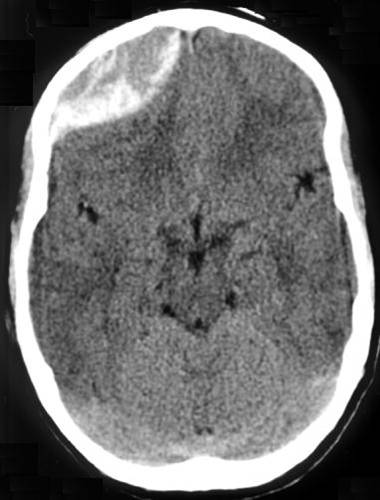
Two answers. Scanning everyone finds a few more lesions but costs radiation, time and beds. NICE makes dose minimisation a recommendation in its own right, for all ages NG232 1.5.7, and the argument bites hardest in children, whose paediatric rules were explicitly built around the risk of radiation-induced malignancy. Kuppermann 2009 Scanning by gestalt alone is worse than it feels: the decision-rule literature exists because unaided judgement both over-scans and misses cases. The rule is a floor, not a ceiling — nothing in NG232 forbids scanning a patient who worries you.
Keep the outcome in view when you read the numbers in the Evidence tab. The rules were built to be near-perfect at finding patients who need neurosurgery, and only moderately good at finding every trace of blood. Those are different targets, and a rule tuned for one will look poor when judged against the other.
Two clocks, and what each one means
Why some criteria say 1 hour and others say 8, and what happens when the patient arrives late.
The 1-hour list NG232 1.5.8 is a list of features that suggest a lesion big enough, or a brain sick enough, that the answer changes management now: GCS 12 or less at the door; GCS below 15 two hours after injury; suspected open or depressed skull fracture; any sign of basal skull fracture; a post-traumatic seizure; a focal neurological deficit; more than one episode of vomiting.
The 8-hour list NG232 1.5.9 applies only to people who lost consciousness or have amnesia, and then asks for one of: age 65 or over, any current bleeding or clotting disorder, a dangerous mechanism, or more than 30 minutes of retrograde amnesia. These raise the probability of finding something without implying it is expanding while you talk.
Both 1.5.9 and the anticoagulant recommendation contain the same clause: if the person presents more than 8 hours after the injury, the scan is within the hour. NG232 1.5.9, 1.5.13 The logic is simple once seen — the 8-hour window was a permission to wait, and the waiting has already happened.
The hour is a surgical window
An extradural haematoma expands; a patient with a lucid interval declares themselves by deteriorating, and the interval is not reliably long. NICE reinforces this on the other side of the scan: a provisional written radiology report must be available within an hour of the scan NG232 1.5.14, and anyone with new surgically significant abnormalities is discussed with a neurosurgeon. NG232 1.4.15 An hour-target CT that sits unreported for three hours has not achieved anything.
If your department cannot deliver the scan in the indicated window — no scanner, or a patient too agitated to lie still — that is itself an admission criterion, not a reason to downgrade the decision. NG232 1.9.1
GCS is a measurement, not a label
The single most common way this pathway fails is treating “GCS 15” as a property of the patient rather than a reading at a time.
Two of the 1-hour criteria are GCS criteria, and they are deliberately different from each other. One is GCS 12 or less on initial assessment in the emergency department. The other is GCS less than 15 at 2 hours after the injury. NG232 1.5.8 The second is not a restatement of the first; it exists because a patient can arrive at 15 and be 14 an hour later, and that trajectory is the finding.
This is why NICE asks for a trained assessment within 15 minutes of arrival NG232 1.4.7, immediate assessment for anyone with a GCS below 15 NG232 1.4.4, and re-examination by an ED clinician even for people triaged as low risk. NG232 1.4.9 The pathway assumes somebody looks twice.
Two traps in reading the number
The baseline. In dementia, chronic neurological disease or learning disability the pre-injury GCS may not be 15, and NICE asks you to establish it and take it into account. NG232 1.3.5 It works in both directions: a GCS of 14 that was 14 last week is not a deterioration, and a GCS of 15 in someone whose baseline is 15 tells you nothing has changed yet.
Alcohol and drugs. The most quotable sentence in the guideline is also the most ignored: “Only assume a depressed conscious level is due to intoxication after an important traumatic brain injury has been excluded.” NG232 1.4.2 Intoxication is a reason the assessment is unreliable, never an explanation for it.
The words that decide the case
Vomiting, amnesia, mechanism — three criteria that are more precise than they look, and one internal contradiction NICE has not resolved.
Vomiting. For adults the threshold is more than 1 episode, so a single vomit is not a criterion and a second one converts the patient to a 1-hour scan. For under-16s the equivalent is 3 or more discrete episodes, and it is one of the second-tier factors, not an automatic scan. NG232 1.5.8, 1.5.11 Two different numbers for two different populations is not an inconsistency; using the adult number on a child is.
Dangerous mechanism is defined, and the definition is narrower than the phrase feels. For the adult CT head criteria it is a pedestrian or cyclist struck by a motor vehicle, an occupant ejected from a motor vehicle, or a fall from more than 1 m or 5 stairs. NG232 1.5.9 The C-spine list is longer and includes axial load, rollover, high-speed collision, motorised recreational vehicles and bicycle collisions. NG232 1.6.2 Five stairs is a specific number; “fell down the stairs” is not the same statement.
Retrograde versus anterograde. The 30-minute criterion is retrograde amnesia — loss of memory for events before the impact — and is easy to mistake for the far commoner post-traumatic (anterograde) gap. Ask specifically what the last thing they remember before the fall was, and time it.
Anticoagulants: the word is “consider”
The only place in the imaging criteria where NICE softens the verb, and it did so on purpose.
Recommendation 1.5.13 covers people with no other indication for a CT head who are on an anticoagulant — vitamin K antagonists, DOACs, heparins — or an antiplatelet excluding aspirin monotherapy. For them, NICE says consider a CT within 8 hours, or within the hour if they present beyond 8 hours. NG232 1.5.13
Two features of that wording carry the clinical weight. “Consider” in NICE language is a weaker recommendation than “do”, and it invites a conversation rather than a reflex. And aspirin alone is outside the recommendation altogether — a patient on aspirin with no other criterion has no NG232 indication for a scan, which surprises people who have absorbed “blood thinner equals scan”.
NICE gives two worked reasons for scanning within that window: it is hard to do a reliable risk assessment, or the person might not come back if they deteriorate. Both are social and practical as much as physiological, and both are much more often true of the frail, isolated older patient than the well-supported one.
A review of the AHEAD study evidence argued that patients on warfarin with GCS 15 and no head injury symptoms have a reduced risk of adverse outcome and “may not need to be scanned”, and that clinicians should feel able to discuss the risk and sometimes decide not to scan. Mason 2019 Review of observational evidence That is a defence of “consider”, not an argument for never scanning.
The second question — the repeat scan. NG232 does not ask for routine repeat imaging or prolonged observation after a normal CT in an anticoagulated patient, and local practice varies widely. In a retrospective single-centre cohort of 596 anticoagulated adults with mild injury and a negative first CT who all had a second scan at 24 hours, delayed intracranial haemorrhage was found in 2% (12 patients), and complications of hospitalisation — mostly infection and delirium — occurred in 66% of those admitted with it. Giamello 2025 Retrospective, single centre Admission is not a neutral act in an 83-year-old.
If the scan does show haemorrhage, reversal is a separate decision with its own guidance; NG232 points to NICE’s blood transfusion guideline for vitamin K antagonists and to MHRA advice for DOACs. NG232 1.5.13 The bleeding and reversal module runs that pathway.
The neck: three questions in a fixed order
The order is the safety mechanism. Taken out of order, the rotation test becomes dangerous rather than reassuring.
The adult C-spine pathway asks, in this sequence: are there high-risk factors? If not, is there any low-risk feature that makes it safe to assess movement? Only then: can the patient actively rotate 45° each way?
The high-risk factors are GCS 12 or less, intubation, an urgent need for definitive diagnosis, blunt polytrauma involving the head and chest, abdomen or pelvis in someone alert and stable, and — where there is clinical suspicion of C-spine injury — age 65 or over, a dangerous mechanism, focal peripheral neurological deficit, or paraesthesia in the limbs. Any of these means CT within an hour. NG232 1.6.2
In a patient with neck pain or tenderness and no high-risk factor, three things each mean CT within an hour: movement cannot be safely assessed, safe assessment shows they cannot rotate 45° each way, or they have a condition predisposing to cervical spine injury such as axial spondyloarthritis. NG232 1.6.3 The ankylosed spine deserves its own reflex: it fractures through the fused column after apparently trivial force, the fracture is often unstable, and plain films are poor at showing it.
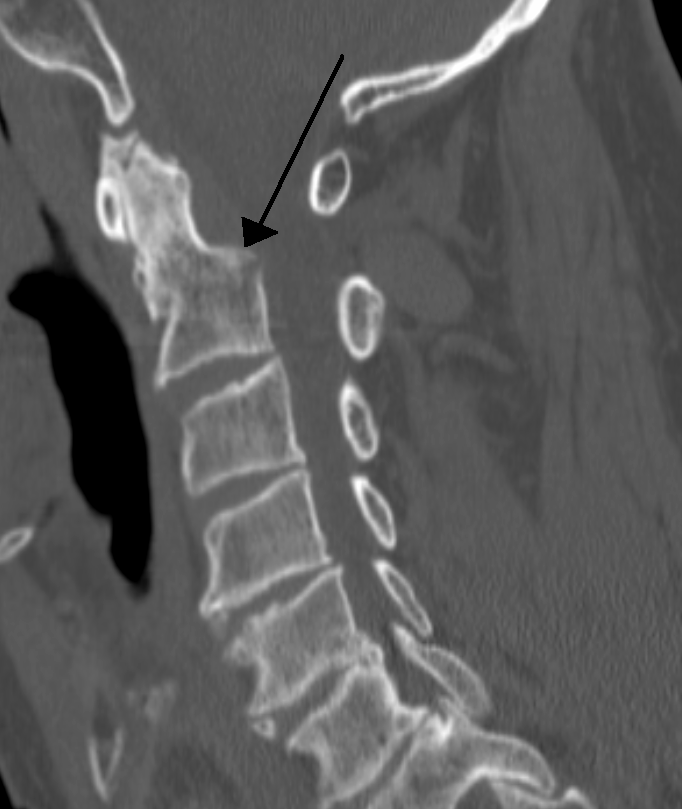
Delayed presentation. Both C-spine recommendations open by explicitly including people who present late. NG232 1.6.2, 1.6.4 The patient who has had neck pain since a collision three days ago is inside the criteria, not outside them.
Clearing the neck. After normal imaging, NICE considers the risk low enough for transfer to the community if the GCS is 15, examination is normal, there is no other reason to admit, and there is competent supervision at home. NG232 1.10.3 Note how much of that is about the person’s circumstances rather than their scan.
Under 16: a different rule, not a scaled-down one
Counting risk factors, a 4-hour observation branch, X-rays before CT for the neck, and safeguarding running through all of it.
The paediatric CT head criteria have a structure adults do not have. Some factors mean a scan within the hour on their own — suspected non-accidental injury, post-traumatic seizure, GCS below 14 at initial assessment (below 15 for babies under 1 year), GCS below 15 at 2 hours, suspected open or depressed fracture or tense fontanelle, any sign of basal skull fracture, focal neurological deficit, and in babies under 1 year a bruise, swelling or laceration over 5 cm on the head. NG232 1.5.10
Six others — witnessed loss of consciousness lasting more than 5 minutes, abnormal drowsiness, 3 or more discrete vomits, a dangerous mechanism (for the paediatric head criteria a different list: a high-speed road traffic accident as pedestrian, cyclist or vehicle occupant, a fall from more than 3 m, or a high-speed injury from a projectile or object — not the adult 1 m or 5 stairs), amnesia over 5 minutes, or a bleeding or clotting disorder — only mandate a scan when more than one is present. NG232 1.5.11
With exactly one of those six, the child is observed for a minimum of 4 hours from the time of injury. If GCS falls below 15, there is further vomiting, or another episode of abnormal drowsiness, CT within 1 hour. If none occur, NICE hands it back to clinical judgement about longer observation. NG232 1.5.12 This is a structured way of buying information instead of radiation — but it only works if the observation is real, documented and reviewed.
The neck is the bigger divergence. For under-16s, CT is reserved for a defined list — GCS 12 or less, intubation, focal peripheral neurological signs, limb paraesthesia, an urgent need for definitive diagnosis, other body areas being scanned with clinical suspicion of C-spine injury, strong suspicion despite normal X-rays, technically inadequate X-rays, or X-rays showing significant bony injury. NG232 1.6.4 Otherwise, for a child with neck pain or tenderness and no CT indication, the pathway is 3-view X-rays first — for a dangerous mechanism (here the 1 m or 5 stairs list, as for adult necks), when safe assessment of movement is not possible, or when the child has a condition predisposing to cervical spine injury such as collagen vascular disease, osteogenesis imperfecta or axial spondyloarthritis; and also when safe assessment shows the child cannot rotate 45° each way. NG232 1.6.5, 1.6.6 Reaching for CT first in a child is a real deviation from the guideline, not a cautious version of it.
Safeguarding is not an add-on. Suspicion of non-accidental injury is a 1-hour CT criterion, and NICE separately asks clinicians to consider abuse or neglect as a cause of any head injury and to involve someone trained in safeguarding. NG232 1.4.12, 1.4.13 An injury that does not match the history, or a head injury in a non-mobile baby, is a safeguarding presentation that happens to involve a scanner.
After the scan — the part the tool cannot do for you
Most of the deaths in this pathway are not missed scans. They are missed deteriorations.
NG232 gives explicit admission criteria: new clinically important abnormalities on imaging; a GCS that has not returned to 15 or to the person’s baseline regardless of the scan; an indicated CT that cannot be done in time; continuing worrying symptoms such as persistent vomiting, severe headache or seizures; and other sources of concern including suspicion of ongoing post-traumatic amnesia, intoxication, other injuries, shock, suspected non-accidental injury, meningism or CSF leak. NG232 1.9.1
It also defines what deterioration looks like in numbers: agitation or abnormal behaviour; a sustained drop of 1 point in GCS for at least 30 minutes, weighted towards the motor score; a drop of 3 or more in eye or verbal, or 2 or more in motor; severe or increasing headache or persistent vomiting; new or evolving signs such as unequal pupils or asymmetry of movement. NG232 1.9.13 A confirmed change triggers reappraisal by a supervising doctor and consideration of an immediate scan. NG232 1.9.15 And if a normal-CT patient is still not GCS 15 at 24 hours, consider further imaging. NG232 1.9.16
Discharge has a hard floor. Do not discharge until the GCS is 15 — or back to the documented pre-injury baseline — and, in preverbal children, until consciousness is normal on the paediatric GCS. NG232 1.10.4 Everyone discharged gets verbal and printed advice NG232 1.10.8; the estate’s head injury discharge leaflet exists for that.
Ten pitfalls
Each of these has a plausible-sounding logic, which is why they survive handovers.
01Reading GCS 15 as “no significant injury”
- Why it happens
- The number is reassuring, prominent and easy to document.
- Instead
- GCS 13–15 is the population the whole rule was built for; 8% of that derivation cohort had a clinically important injury. Stiell 2001
02Never taking the 2-hour GCS
- Why it happens
- The patient is settled, the department is busy, and the criterion needs someone to come back.
- Instead
- It is a criterion, not an observation. Diary it: GCS below 15 at 2 hours after injury is a 1-hour CT. NG232 1.5.8
03Blaming alcohol for the GCS
- Why it happens
- The explanation fits, and intoxicated patients are hard to assess.
- Instead
- NICE inverts it: assume intoxication only after an important brain injury has been excluded. NG232 1.4.2 Intoxication is also, separately, a reason to admit. NG232 1.9.1
04Treating aspirin as an anticoagulant
- Why it happens
- “On blood thinners” is how it gets handed over.
- Instead
- Aspirin monotherapy is explicitly excluded from 1.5.13. Ask which drug, not whether there is one. NG232 1.5.13
05Turning “consider” into an automatic scan — or into nothing
- Why it happens
- Both are easier than a conversation about risk.
- Instead
- Decide explicitly, using the two reasons NICE gives (unreliable risk assessment, unlikely to return), and document the decision either way. NG232 1.5.13 Mason 2019
06Testing neck rotation to avoid a scan
- Why it happens
- It feels like the rule, and a normal result feels like clearance.
- Instead
- Rotation is only valid with no high-risk factors and at least one low-risk feature. Otherwise the answer means nothing and the movement is a risk. NG232 1.6.1
07Missing the older patient’s low-energy fall
- Why it happens
- “Mechanical fall” is a category that ends thinking.
- Instead
- Age 65 or over is a risk factor for the head (with LOC or amnesia) and, with clinical suspicion, a high-risk factor for the neck. NG232 1.5.9, 1.6.2 See also the silver trauma module.
08Using the adult vomiting threshold in a child
- Why it happens
- “More than one vomit” is the number people remember.
- Instead
- For under-16s it is 3 or more discrete episodes, and it is a count-towards factor rather than an automatic scan. NG232 1.5.11
09Going straight to CT neck in a child
- Why it happens
- It is what we do for adults, and it feels more thorough.
- Instead
- Under-16s get 3-view X-rays first unless one of the specific CT indications applies. NG232 1.6.4–1.6.6
10Discharging on a normal scan alone
- Why it happens
- The scan is the event everyone was waiting for.
- Instead
- Discharge needs GCS 15 or baseline, no other admission criterion, somewhere safe to go, and written advice. NG232 1.9.1, 1.10.4, 1.10.5, 1.10.8
Seven red herrings
Findings that feel like they close the case and do not.
It is the inclusion criterion for minor head injury, not an exclusion of injury. In one GCS-15 cohort, 5.3% had a clinically important brain injury. Stiell 2005
Being ambulatory is one of the low-risk features that permits a rotation test — it is a permission to examine, never a reason to skip imaging. NG232 1.6.1
The entire 1-hour list runs without any LOC at all. LOC only gates the 8-hour criteria. NG232 1.5.8, 1.5.9
A fall from more than 1 m or 5 stairs is a dangerous mechanism by definition, and in the older patient the mechanism is often understated. NG232 1.5.9
True, and it does mean 1.5.13 does not apply — but it says nothing about the other criteria, which are assessed exactly as usual. NG232 1.5.13
They are decided independently and imaged differently. A normal CT head says nothing about the cervical spine, and NG232 keeps the two sets of criteria in separate sections. NG232 1.5.8, 1.6.2
A normal CT does not exclude concussion, does not raise a GCS of 14 to 15, and does not create supervision at home. All three are separate discharge requirements. NG232 1.10.4, 1.10.5
The case revisited
- Age 78. Age 65 or over is an 8-hour CT head risk factor when there has been LOC or amnesia, and a C-spine high-risk factor when there is clinical suspicion. NG232 1.5.9, 1.6.2
- A fall of about 2 metres down the stairs. NG232 defines a dangerous mechanism as a fall from a height of more than 1 m or 5 stairs, so this qualifies on height — note that a fall down exactly five stairs would not meet the stairs half of that wording. NG232 1.5.9, 1.6.2
- She cannot remember the fall. Amnesia opens the 8-hour pathway — and, read through the guideline’s own definition of focal neurological deficit, arguably the 1-hour one. Document which reading you used. NG232 1.5.8, 1.5.9
- One vomit. Not yet a criterion in an adult. A second one makes it a 1-hour scan, so this is a patient to re-examine rather than park. NG232 1.5.8
- Apixaban. Even with no other indication, 1.5.13 applies — but here there already are other indications, so the scan is not a “consider”. NG232 1.5.13
Neck. She has neck pain, is 65 or over and had a dangerous mechanism, so if there is clinical suspicion of C-spine injury she meets a high-risk factor: CT cervical spine within 1 hour. The fact that she walked in and rotates her neck does not enter the decision, because rotation may only be assessed when there are no high-risk factors. NG232 1.6.1, 1.6.2
Head. LOC or amnesia plus age 65 or over plus a dangerous mechanism: CT head within 8 hours — brought forward if she vomits again, if her GCS is below 15 at 2 hours, or if you take the focal-deficit reading of her amnesia. NG232 1.5.8, 1.5.9
And the GCS of 15 in the triage note is true, unhelpful, and the reason the pathway needs a second look at 2 hours.
NG232 does not name a decision rule anywhere in its recommendations, but the criteria are recognisably descended from a body of work built in the late 1990s and 2000s: large prospective cohorts, recursive partitioning, and outcomes chosen to make the rules very good at one thing. This is what those studies actually found, including the external validation that puts the NICE rule itself in an uncomfortable light.
The evidence map
| Question | Best evidence | Design | Strength |
| Which adults with minor head injury need CT? | Canadian CT Head Rule; New Orleans Criteria | Prospective derivation and comparison cohorts | Strong for neurosurgical outcomes; weaker for any CT finding |
| Does the NICE rule itself perform? | Foks 2018 | Prospective multicentre validation | Moderate — and the result is sobering |
| Which alert adults need C-spine imaging? | Canadian C-Spine Rule; NEXUS | Large prospective cohorts, one head-to-head | Strong |
| Which children need a CT head? | PECARN; CHALICE; PREDICT validation | Very large prospective cohorts | Strong for the rules as designed |
| Should anticoagulated patients be scanned, re-scanned, observed? | AHEAD-based review; retrospective delayed-bleed cohorts | Observational, some single centre | Weak — and the reason NICE says “consider” |
| Do imaging rules change patient outcomes? | No randomised evidence identified in these sources | — | Absent |
The Canadian CT Head Rule and the New Orleans Criteria
The Canadian CT Head Rule was derived in 3,121 adults with GCS 13–15 across ten Canadian emergency departments. Clinically important brain injury was present in 8%, and 1% required neurological intervention. Stiell 2001
| Five high-risk factors | Failure to reach GCS 15 within 2 h, suspected open skull fracture, any sign of basal skull fracture, vomiting more than 2 episodes, age over 65 — 100% sensitive (95% CI 92–100) for need for neurological intervention, requiring CT in 32% |
| Two medium-risk factors | Amnesia before impact more than 30 min, dangerous mechanism — 98.4% sensitive (96–99), 49.6% specific for clinically important brain injury, requiring CT in 54% |
| New Orleans Criteria | Derived in 520 and validated in 909 patients with GCS 15: headache, vomiting, age over 60, intoxication, short-term memory deficit, trauma above the clavicles, seizure — 100% sensitive (95–100) for a positive scan Haydel 2000 |
Head-to-head in 1,822 patients with GCS 15, of whom 0.4% needed neurosurgery and 5.3% had clinically important brain injury, both rules were 100% sensitive for neurosurgical intervention, with the Canadian rule far more specific for that outcome (76.3% vs 12.1%). For clinically important brain injury both were 100% sensitive, and the Canadian rule was again more specific (50.6% vs 12.7%) and would result in lower CT rates (52.1% vs 88.0%). Agreement between physicians was also better for the Canadian rule (kappa 0.85 vs 0.47). Stiell 2005
A Dutch validation of the same two rules in 3,181 patients reversed part of that picture: both were 100% sensitive for neurosurgical intervention, but for any neurocranial traumatic finding the New Orleans Criteria were more sensitive (97.7–99.4%) than the Canadian rule (83.4–87.2%), at the cost of almost no specificity (3.0–5.6%). Smits 2005
Foks 2018 — four rules, one Dutch cohort, uncomfortable numbers
Consecutive adults aged 16 and over with GCS 13–15 at nine Dutch hospitals, with the primary analysis restricted to six centres that included patients with and without CT; the CHIP rule, New Orleans Criteria, Canadian CT Head Rule and the NICE head injury guideline were all applied. Of the patients analysed, 8% had an intracranial traumatic finding and 2% a potential neurosurgical lesion. Foks 2018
| Any intracranial traumatic finding | Sensitivity ranged from 73% (NICE) to 99% (NOC); specificity from 4% (NOC) to 61% (NICE) |
| Potential neurosurgical lesion | Sensitivity 85% (NICE) to 100% (NOC); specificity 4% (NOC) to 59% (NICE) |
| Authors’ conclusion | Applying any of the four rules “can lead to a wide variation in CT scanning among patients with minor head injury, resulting in many unnecessary CT scans and some missed intracranial traumatic findings” |
The Canadian C-Spine Rule and NEXUS
The Canadian C-Spine Rule was derived in 8,924 alert, stable adults with GCS 15 after blunt head or neck trauma; 151 (1.7%) had a clinically important C-spine injury. Its three questions — high-risk factor, low-risk feature permitting assessment, then 45° rotation — gave 100% sensitivity (95% CI 98–100) and 42.5% specificity on cross-validation, with a projected imaging rate of 58.2%. Stiell 2001
NEXUS took the opposite approach: five clinical criteria (no midline tenderness, no focal neurological deficit, normal alertness, no intoxication, no distracting injury) applied to 34,069 patients at 21 US centres. It identified all but 8 of 818 injuries — sensitivity 99.0% (98.0–99.6), specificity 12.9% — and would have avoided imaging in 12.6% of patients. Hoffman 2000
Head-to-head in 8,283 alert, stable patients, the Canadian rule was both more sensitive (99.4% vs 90.7%) and more specific (45.1% vs 36.8%) than NEXUS in the analysis excluding the 845 indeterminate cases — counting those as rule-negative instead drops its sensitivity to 95.3%, and would have produced fewer X-rays (55.9% vs 66.6%). It would have missed 1 important injury; NEXUS would have missed 16. In 845 patients (10.2%) physicians did not assess range of movement as the algorithm required. Stiell 2003
PECARN, CHALICE and the PREDICT validation
PECARN enrolled 42,412 children under 18 with GCS 14–15 at 25 North American emergency departments. Clinically important traumatic brain injury occurred in 0.9% and neurosurgery in 0.1%. Its age-specific rules had a negative predictive value of 100% (95% CI 99.7–100) under 2 years and 99.95% at 2 years and over; neither rule missed a neurosurgical case in validation. Kuppermann 2009
CHALICE, a UK rule, was derived in 22,772 children across ten north-west England hospitals, with 98% sensitivity (96–100) and 87% specificity for clinically significant head injury at a 14% CT rate. Dunning 2006
PREDICT compared PECARN, CATCH and CHALICE prospectively in 20,137 children in Australia and New Zealand. CT was obtained in 10%, 23% were admitted, fewer than 1% had neurosurgery. Point sensitivities were highest for PECARN (100% under 2 years; 99.0% at 2 and over), then CATCH high-risk predictors (95.2%) and CHALICE (92.3%); negative predictive values exceeded 99% for all rules. Applicability differed sharply: CHALICE applied to 99% of patients, CATCH to 25%. Babl 2017
Scanning, re-scanning and the risk of delayed bleeding
A review of the evidence around the AHEAD study concluded that international guidance rests on a small number of studies of poor quality, and argued that patients on warfarin with GCS 15 and no head injury symptoms “have a reduced risk of adverse outcome and may not need to be scanned”, supporting an individualised decision. Mason 2019
On the question of what to do after a normal scan, a single-centre Italian retrospective study of 596 anticoagulated adults (median age 83, 74.5% on DOACs, 90.4% falls) who all had a second CT at 24 hours found delayed intracranial haemorrhage in 2% (12 patients). Patients with delayed bleeding more often had high-energy mechanisms (16.7% vs 1.7%, p = 0.044); the difference in arrival GCS below 15 was not significant (16.7% vs 3.9%, p = 0.17). Complications of hospitalisation occurred in 66% of those admitted with delayed haemorrhage. The authors concluded delayed bleeding is “rare and typically benign” and that routine prolonged observation and repeat CT may not be necessary for all patients. Giamello 2025
Reading this literature critically
- The outcome defines the rule. “Need for neurological intervention”, “clinically important brain injury”, “any intracranial traumatic finding” and “clinically significant head injury” are four different targets used across these papers. A rule is only sensitive for its own outcome.
- Derivation flatters. Recursive partitioning finds the combination that fits the derivation set. The Canadian rule’s 100% sensitivity for neurosurgical intervention held in a Dutch cohort, but for any neurocranial traumatic finding it was 83–87%. Smits 2005
- Sensitivity without specificity is not a virtue. NEXUS avoided imaging in 12.6% of patients; a rule that scans nearly everyone is sensitive by construction. Hoffman 2000
- Interobserver agreement is part of accuracy. Kappa 0.85 versus 0.47 for two rules on the same patients means one of them is being applied consistently and the other is not. Stiell 2005
- Applicability is a hidden denominator. CHALICE applied to 99% of a paediatric cohort and CATCH to 25%. A more accurate rule you cannot apply is worth less at the bedside. Babl 2017
- Case mix travels badly. These cohorts are Canadian, American, Dutch, Australasian and British, with different thresholds for attending and scanning. A UK guideline validated abroad is being tested in a system that does not select patients the same way.
- None of this measures patient outcome. Every study here is diagnostic accuracy or observational risk. No randomised trial in these sources shows that using any rule changes death or disability — only how many scans are done and how many findings are caught.
NG232 is the standard UK practice is audited against, and its criteria are defensible, explicit and applied consistently enough to be teachable. It is also, on the only external validation here, the most conservative of four rules about who gets scanned — which means fewer scans, more specificity, and a real minority of intracranial findings not captured by the criteria. Both things are true. Follow the guideline, scan outside it when the patient in front of you demands it, write down why, and recognise that the 2-hour GCS, the second look and the discharge conversation are doing at least as much work as the criteria themselves.
What this module is, what it deliberately does not do, where every claim came from, and who reviewed it.
What this is
A single-page implementation of the NICE NG232 imaging criteria for head and cervical spine injury, with the reasoning and the underlying evidence alongside it. The Decision tool tab runs the criteria; the Teaching and Evidence tabs explain and appraise them.
What it does not do. It does not decide whether someone has a head injury, manage raised intracranial pressure, cover penetrating head injury beyond the imaging criteria, give drug doses, replace a discussion with your neurosurgical centre, or reproduce NG232 in full — only the recommendations that bear on imaging, observation and discharge. It is not a substitute for reading the guideline.
How the sources were used
NG232 recommendations were taken from the full recommendations text on the NICE website and quoted directly; every recommendation number on these pages points at the numbered recommendation it quotes. For every research study cited, the figures on this page come from the published abstract, retrieved from PubMed — not from full texts, review articles or secondary summaries. Where a study is described as retrospective, single-centre, or from a particular country, that description is taken from the abstract itself.
NG232 does not name the Canadian CT Head Rule, NEXUS, the Canadian C-Spine Rule, PECARN, CHALICE or CATCH in its recommendations. They appear here as the evidence background, tagged as decision rules rather than as guidance, because in UK practice NG232 is what applies.
References
- National Institute for Health and Care Excellence. Head injury: assessment and early management. NICE guideline NG232, 2023. nice.org.uk/guidance/ng232
- Stiell IG, Wells GA, Vandemheen K, Clement C, et al. The Canadian CT Head Rule for patients with minor head injury. Lancet 2001;357(9266):1391–6. PMID 11356436.
- Haydel MJ, Preston CA, Mills TJ, Luber S, et al. Indications for computed tomography in patients with minor head injury. N Engl J Med 2000;343(2):100–5. PMID 10891517.
- Stiell IG, Clement CM, Rowe BH, Schull MJ, et al. Comparison of the Canadian CT Head Rule and the New Orleans Criteria in patients with minor head injury. JAMA 2005;294(12):1511–8. PMID 16189364.
- Smits M, Dippel DW, de Haan GG, Dekker HM, et al. External validation of the Canadian CT Head Rule and the New Orleans Criteria for CT scanning in patients with minor head injury. JAMA 2005;294(12):1519–25. PMID 16189365.
- Foks KA, van den Brand CL, Lingsma HF, van der Naalt J, et al. External validation of computed tomography decision rules for minor head injury: prospective, multicentre cohort study in the Netherlands. BMJ 2018;362:k3527. PMID 30143521.
- Stiell IG, Wells GA, Vandemheen KL, Clement CM, et al. The Canadian C-spine rule for radiography in alert and stable trauma patients. JAMA 2001;286(15):1841–8. PMID 11597285.
- Hoffman JR, Mower WR, Wolfson AB, Todd KH, Zucker MI. Validity of a set of clinical criteria to rule out injury to the cervical spine in patients with blunt trauma. National Emergency X-Radiography Utilization Study Group (NEXUS). N Engl J Med 2000;343(2):94–9. PMID 10891516.
- Stiell IG, Clement CM, McKnight RD, Brison R, et al. The Canadian C-spine rule versus the NEXUS low-risk criteria in patients with trauma. N Engl J Med 2003;349(26):2510–8. PMID 14695411.
- Kuppermann N, Holmes JF, Dayan PS, Hoyle JD Jr, et al. Identification of children at very low risk of clinically-important brain injuries after head trauma: a prospective cohort study. Lancet 2009;374(9696):1160–70. PMID 19758692.
- Dunning J, Daly JP, Lomas JP, Lecky F, et al. Derivation of the children’s head injury algorithm for the prediction of important clinical events decision rule for head injury in children. Arch Dis Child 2006;91(11):885–91. PMID 17056862.
- Babl FE, Borland ML, Phillips N, Kochar A, et al. Accuracy of PECARN, CATCH, and CHALICE head injury decision rules in children: a prospective cohort study. Lancet 2017;389(10087):2393–2402. PMID 28410792.
- Mason SM, Evans R, Kuczawski M. Understanding the management of patients with head injury taking warfarin: who should we scan and when? Lessons from the AHEAD study. Emerg Med J 2019;36(1):47–51. PMID 30065073.
- Giamello JD, Martini G, Fulcheri C, Visconti GL, et al. Impact of anticoagulant therapy on delayed intracranial haemorrhage after traumatic brain injury: a study on the role of repeat CT scans and extended observation. Injury 2025;56(9):112523. PMID 40537351.
Image credits
- Acute extradural haematoma on CT — Jpogi, via Wikimedia Commons, CC BY-SA 3.0.
- Fracture of the base of the dens on CT — James Heilman, MD, via Wikimedia Commons, CC BY-SA 3.0.
Both images are of unnamed patients and are used illustratively; neither depicts a patient of this site’s author.