A broken bone, a bruise, a head injury — the same findings that are unremarkable in one child are the most important thing you will see all shift in another. What changes is not the injury but its fit: with the child's age and development, with the history offered, and with the other things you find when you look. This chapter is about learning to see the mismatch, and about the reflex that must follow it — not to accuse, but to suspect, refer, and keep the child safe while others establish what happened.
A 5-month-old is brought to the ED at 22:00 by one parent. There is a bruise over the left cheek and a smaller one behind the ear. The history is that the baby "rolled off the sofa" this afternoon; the injury was noticed at bath time. The baby is alert, feeding, and settles quickly. The parent is calm, apologetic, and keen to get home. Observations are normal. A colleague suggests documenting "accidental bruise, safety-netting given" and discharging.
By the end of this chapter you should be able to say why almost nothing in that paragraph is reassuring, which single fact matters most, and what the law then requires of you. The answers are at the bottom.
Why we do what we do, in one table
The recognition principles this chapter is built on, and where each comes from.
| The principle | Why | Basis |
|---|---|---|
| Any injury in a non-mobile baby is concerning until explained | A child who cannot roll, crawl or cruise cannot generate the forces to bruise or fracture themselves. Bruising is present in under 1% of non-mobile infants. | CG89 1.1.2 Sugar 1999 · Maguire 2005 |
| Judge the injury against the developmental stage, not the calendar age | "Cruising" — not a birthday — is what makes accidental bruising plausible. "Those who don't cruise rarely bruise." | Sugar 1999 |
| The history matters as much as the injury | An absent, vague, changing or developmentally impossible account, or a delay in presenting, is itself an alerting feature. | CG89 (unsuitable explanation) Teaching |
| Certain patterns are specific: hand/ligature/implement marks, non-bony sites, clusters | They carry the imprint of the mechanism; accidental bruising is small, over bony prominences, on the front of the body. | CG89 1.1.1–1.1.2 Pierce 2010/2021 |
| Suspect abuse with a fracture unless there is a medical cause or suitable explanation | No single fracture proves abuse, but rib fractures in infants carry the highest probability, and occult fractures are common. | CG89 1.1.9 Kemp 2008 |
| Think abusive head trauma in the under-3 with intracranial injury and no major accident | Retinal haemorrhages, rib/long-bone fractures or multiple subdurals alongside the head injury raise the concern. | CG89 1.1.10–1.1.11 PredAHT |
| One injury is a reason to look for others | Inflicted injuries cluster and are often of different ages; the visible one may be the least of them. | CG89 1.1.9 (occult) skeletal survey |
| "Suspect" triggers referral; "consider" triggers looking harder | NICE separates the two deliberately. Neither requires you to be certain, and neither is a diagnosis. | CG89 terms used |
| Your duty is to refer a suspicion, not to prove a case | The statutory threshold — "reasonable cause to suspect … significant harm" — is low by design, and it is the social worker's job, not yours, to establish what happened. | CA 1989 s.47 |
Non-accidental injury is a way of seeing, not a diagnosis
Why the label you are reaching for is "concern", not "abuse".
"Non-accidental injury" — child physical abuse — is not something you diagnose at the front door. It is something you suspect, and a suspicion is enough to act on. The whole edifice of UK child protection is built to take the burden of certainty off the person who first sees the child: you flag a concern, and a multi-agency process — social care, the police, paediatrics, sometimes the courts — establishes what happened. If you wait until you are sure, you have waited too long, and often you will never be sure at all.
NICE captures this in two words it uses with precision throughout CG89. Consider maltreatment means it is one possible explanation for the finding, and you should look for other alerting features and gather more information. Suspect maltreatment means there is a serious level of concern but not proof — and it is the trigger to refer the child to children's social care. CG89 Neither word asks you to be right. Both ask you to act.
For every injury in a child, ask: does this injury, in this child, with this history, make sense? If the mechanism offered could not produce this injury, or this child could not have done what is described, or the story keeps changing, or nobody sought help for hours — the injury does not fit, and a non-fitting injury is the finding. The injury itself may be trivial. The mismatch is not.
Two facts about scale keep the reflex sharp. First, physical abuse concentrates in the youngest: inflicted fractures are most common in infants under one and toddlers up to three Kemp 2008, and abusive head trauma is overwhelmingly a disease of babies. Second, it is missed — repeatedly, and often more than once, before the injury that finally kills or maims. The "sentinel injury" — a minor bruise or intra-oral injury in a young infant, seen and dismissed weeks before a catastrophic presentation — is a recurring theme of serious case reviews. Teaching The bruise you are tempted to wave through may be the warning that was there all along.
The history is half the examination
Why "unsuitable explanation" is a clinical finding, not a value judgement.
NICE ties almost every physical alerting feature to the same qualifier: the injury raises concern where the explanation is absent or unsuitable. CG89 An explanation is unsuitable when it does not account for the injury, is not consistent with the child's development, keeps changing, is given differently by different carers, or when there was an unexplained delay in seeking help. None of these, on its own, means abuse. All of them mean the story and the injury do not line up, which is exactly what you are meant to notice.
Take the history without cross-examining. Your role in the ED is to record — not to interview the child forensically, and not to confront the carer. Ask open questions, write down the answers in the words used (with quotation marks), note who gave the history and when, and note the time between the injury and the presentation. A carefully documented history taken at 22:00 is evidence; a leading question or an accusation is not, and can compromise both the child's protection and any later legal process. Teaching
- No history at all for a real injury in a young child — the account is "I just found it" — is itself an alerting feature.
- A mechanism the child could not perform — "he rolled over" in a baby who cannot yet roll — is a developmental impossibility, and the most useful thing you can document.
- A shifting story — the mechanism changes between the triage note, your history, and the nurse's — matters more than any single version.
- Delay in presenting a painful or frightening injury, without a reason, is an alerting feature in its own right (explicit for visceral injury in CG89 1.1.13).
Bruising: the commonest sign, and the one most often missed
Why a bruise on a baby who cannot yet move is the whole subject in one finding.
Bruising is the most common — and the most commonly overlooked — presentation of physical abuse, and it is where the developmental-stage rule does its clearest work. In a landmark community study of nearly a thousand normal children, bruises were found in only 0.6% of babies under six months and in just 2.2% of children not yet cruising, rising to 17.8% of cruisers and 51.9% of walkers. Sugar 1999 The line the authors drew has become the aphorism every ED clinician should carry: those who don't cruise rarely bruise. A bruise in a child who cannot yet get about under their own steam is abnormal until proven otherwise.
The pattern and site separate accidental from inflicted bruising. Accidental bruises are small, sit over bony prominences (shins, knees, forehead in a toddler), and are on the front of the body. Inflicted bruises are away from bony prominences, cluster, are commonly multiple, may carry the imprint of an implement, and favour the head and neck — especially the face — then the buttocks, trunk and arms. Maguire 2005 NICE turns this into instructions to suspect maltreatment: bruising shaped like a hand, ligature, stick, teeth, grip or implement; or bruising that is unexplained and falls into examples including bruising in a child who is not independently mobile, multiple bruises or clusters, bruises of similar shape and size, bruises on non-bony parts including the eyes, ears and buttocks, bruises on the neck like attempted strangulation, and bruises on the ankles and wrists like ligature marks. CG89 1.1.1–1.1.2
The bruising clinical decision rule refined and validated by Pierce and colleagues flags bruising to the Torso, Ear or Neck in a child ≤4 years, or any bruising in an infant ≤4 months, extended to the Frenulum, Angle of jaw, Cheek, Eyelid and Subconjunctivae, plus any patterned bruising. Pierce 2021 It is a screen to prompt evaluation, derived and validated in US paediatric settings — useful for teaching the high-risk sites, not a substitute for the NICE alerting features or your local pathway. A negative rule does not clear a worrying child.
One more caution: do not attempt to age a bruise by its colour. The old teaching that colour reliably dates a bruise has not survived scrutiny, and a confident "this is about four days old" written in the notes can be discredited in court and undermine the whole assessment. Describe what you see — site, size, shape, colour — and leave the dating to those with the evidence base for it (there largely isn't one). Teaching
Fractures: which ones, and why the skeletal survey exists
Why no fracture proves abuse, and no single film clears it.
NICE says to suspect maltreatment when a child has one or more fractures, in the absence of a bone-fragility condition (such as osteogenesis imperfecta or osteopenia of prematurity) or a suitable explanation — and it names two presentations in particular: fractures of different ages, and occult fractures found on X-ray that were not clinically evident, "for example, rib fractures in infants". CG89 1.1.9 Those two phrases contain the whole reason a skeletal survey exists.
The systematic review behind the concern is Kemp's. Across 32 studies it found inflicted fractures throughout the skeleton, commonest in infants and toddlers, with multiple fractures more common in abuse. Once major trauma was excluded, rib fractures carried the highest probability of abuse (0.71, 95% CI 0.42–0.91); humeral fractures 0.48–0.54, femoral 0.28–0.43 (with the child's developmental stage an important discriminator), and skull fractures 0.30. Its central conclusion is the one to remember: no fracture, on its own, can distinguish an abusive from a non-abusive cause. Kemp 2008 Probability is not proof, in either direction.
Some fracture types are, nonetheless, strongly associated with inflicted injury by their mechanism:
- Posterior rib fractures in an infant. They result from anteroposterior compression of the chest — a squeeze — not from the anterior/lateral pattern of the rare CPR-related rib injury, and not from normal handling. In the Kemp data they carried the highest abuse probability.
- Classic metaphyseal lesions (the "corner" or "bucket-handle" fracture) at the ends of long bones, produced by shearing/tractional forces on the infant metaphysis — grabbing and pulling or twisting a limb. They are subtle on plain film and highly specific for infant abuse. Teaching
- Multiple fractures, fractures of different ages, and occult fractures — the constellation the skeletal survey is designed to reveal.
When physical abuse is suspected in a young child (UK practice: under two years), a full skeletal survey — a defined series of dedicated radiographs, not a single "babygram" — is the first-line imaging, with a follow-up survey around 11–14 days later to catch healing fractures invisible on the first, performed and reported to the RCR/RCPCH national standards. This is a paediatric and radiology decision, made with the safeguarding team, not something initiated and interpreted single-handed in the ED. RCR/RCPCH standard Teaching
The head: abusive head trauma
The most lethal presentation, and the one whose signs are inside the skull.
Abusive head trauma (the older term is "shaken baby syndrome") is the leading cause of fatal physical abuse in infants, and the one where the crucial findings are not on the skin. Teaching NICE says to suspect maltreatment when a child has an intracranial injury with no major confirmed accidental trauma or medical cause, in any of these circumstances: the explanation is absent or unsuitable; the child is under three years; there are also retinal haemorrhages, or rib or long-bone fractures, or other associated inflicted injuries; or there are multiple subdural haemorrhages with or without subarachnoid haemorrhage or hypoxic–ischaemic damage. CG89 1.1.10 Separately, it says to suspect maltreatment for retinal haemorrhages or eye injury with no major accident or known medical cause including birth. CG89 1.1.11
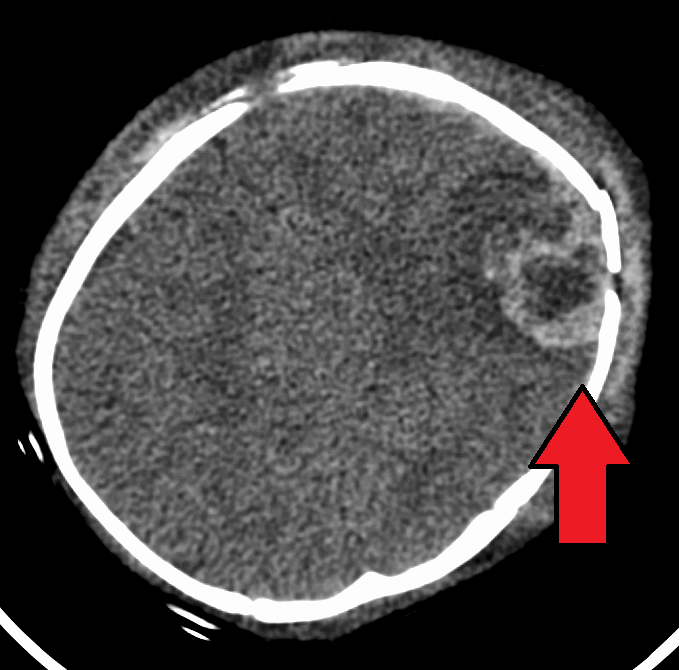

The presentation is treacherous precisely because it can be occult. A shaken infant may arrive with nothing but a history of "not himself" — vomiting, floppiness, a brief apnoea, a seizure — and normal external examination. The threshold for imaging the head of a young infant with unexplained neurological symptoms, or with any other inflicted injury, has to be low. Teaching
The Cardiff group's Predicting Abusive Head Trauma (PredAHT) tool estimates the probability of abusive head trauma from a combination of six features: head or neck bruising, seizures, apnoea, retinal haemorrhage, rib fracture and long-bone fracture. Cowley 2018 It is an adjunct to specialist judgement in a child already being investigated for AHT — not an ED rule-out, and its own evaluation found professionals wary of a low score giving false reassurance and unsure of its standing in court. It belongs to the paediatric/child-protection assessment, referenced here so you recognise the six features, not so you calculate a number at triage.
Retinal haemorrhages deserve one line of caution: they are found in some accidental trauma and in medical conditions, and a competent examination for them is an ophthalmologist's dilated fundoscopy, not a direct-ophthalmoscope glance in the resus bay. Their character — multiple, multilayered, extending to the periphery — is what makes them concerning, and that is a specialist call. Teaching
Burns, the mouth, the abdomen, the spine — and the cold
The rest of CG89's physical features, each with its own tell.
Thermal injury
Suspect maltreatment with a burn or scald if the explanation is absent or unsuitable, if the child is not independently mobile, on any soft-tissue area that would not normally contact a hot object in an accident (backs of hands, soles, buttocks, back), in the shape of an implement (cigarette, iron), or with the hallmarks of forced immersion: scalds to buttocks, perineum and lower limbs; a glove-or-stocking distribution; symmetry; and sharply delineated borders. CG89 1.1.6 The accidental scald is asymmetrical, has splash marks and an irregular edge, and fits a reach-and-pull mechanism; the immersion injury is symmetrical, uniform-depth, and sharply bordered.
Bites, lacerations and scars
Suspect maltreatment with a human bite mark unlikely to have been made by a young child CG89 1.1.3, and with lacerations, abrasions or scars where the explanation is unsuitable — including on a non-mobile child, multiple, symmetrical, on areas usually protected by clothing, on the eyes/ears/sides of face, or on the neck/ankles/wrists like ligature marks. CG89 1.1.5
Oral injury
Consider maltreatment with an oral injury and an absent or unsuitable explanation. CG89 1.1.14 A torn frenulum in a young infant — sometimes attributed to forced feeding, though the mechanism is debated — is a small injury that has repeatedly turned out to be a sentinel one; look inside the mouth.
Visceral injury
Suspect maltreatment with an intra-abdominal or intrathoracic injury and no major confirmed accidental trauma, where the explanation is absent or unsuitable or there is a delay in presentation — and note NICE's warning that there may be no external bruising or other injury. CG89 1.1.13 Abusive abdominal trauma is the second commonest cause of fatal physical abuse after head injury, and a normal-looking abdominal wall does not exclude it. Teaching
Spine, cold and the general injury
Suspect physical abuse with signs of spinal injury and no major accident — which may appear as a skeletal-survey or MRI finding, as cervical injury with inflicted head injury, or as thoracolumbar injury with focal neurology or unexplained kyphosis. CG89 1.1.12 Consider maltreatment with cold injuries (swollen red hands or feet) or unexplained hypothermia CG89 1.1.7–1.1.8, and with any serious or unusual injury for which there is no suitable explanation. CG89 1.1.15
One injury is a reason to look for others
Why the visible injury may be the least of them.
Inflicted injuries cluster, and they are often of different ages. The bruise that brought the child in may sit over rib fractures you cannot feel, or accompany a subdural you cannot see. This is the logic of the skeletal survey and of considering neuroimaging in the infant, and it is why NICE explicitly lists occult fractures among the presentations that should make you suspect maltreatment. CG89 1.1.9
Two extensions of the same principle belong in the ED clinician's head:
- Examine the whole child, undressed. You cannot find what you do not look for. A full skin survey, the mouth, behind the ears, the frenulum, the buttocks and the soles are all named sites for a reason.
- Think about the siblings. Where one child in a household is being harmed, others may be at risk. The referral you make is about the family's children, not only the one in front of you — and the statutory duty to make enquiries is framed around the child at risk, whoever presents. Teaching
What to do once you have a concern
The steps between "this does not fit" and a safe child — the bridge to the Legal tab.
Recognition is only useful if it is followed by the right actions, in the right order, without confrontation and without delay. The sequence is the same everywhere in the UK; the statutory routes it feeds into differ by nation and are set out under Legal.
- Make the child medically safe first. Resuscitate and treat the injury on its clinical merits. Safeguarding never displaces acute care; it runs alongside it.
- Examine fully and document contemporaneously. Record the history verbatim with quotation marks, who gave it and when, the injury by site/size/shape/colour, and the time from injury to presentation. Body maps and (per local policy and consent) clinical photography help. Do not date bruises by colour; do not editorialise.
- Do not interrogate or accuse. Your job is to record and to refer, not to investigate or to secure a confession. Confrontation can place the child at greater risk and can compromise a later legal process.
- Be honest with the family, within reason. Explain, in general terms, that when a child has an injury like this you are required to seek advice from colleagues and social care. Openness is the default; the exception is where telling the family would put the child at greater risk (for example a risk of removal or of the injury being concealed), when advice is taken first.
- Discuss with your named or designated safeguarding professional and the on-call paediatric team early. You do not carry this alone, and you should not.
- Refer to children's social care when you suspect maltreatment — this is the operative step, and the threshold is suspicion, not proof (CG89; the statutory threshold is the s.47 "reasonable cause to suspect … significant harm"). A telephone referral is confirmed in writing per local procedure. If a child is in immediate danger, that is a police matter, now.
- Keep the child safe in the meantime. Admission is often the safest holding position while assessment proceeds; a child must not be discharged into possible danger to expedite the department.
You are not required to be certain, and you are not required to prove anything. You are required to recognise a concern, act to keep the child safe, and pass the concern to the people whose job it is to investigate it. The law makes the threshold suspicion for exactly this reason — see Legal.
Ten pitfalls
The recurring ways an inflicted injury gets waved through — or a family gets wrongly accused.
01Judging by the injury's severity, not its fit
- The trap
- A tiny bruise looks trivial, so it is dismissed. But a tiny bruise on a non-mobile baby is a major finding.
- Instead
- Judge every injury against the child's development and the history, not by how bad it looks.
02Forgetting to undress the child
- The trap
- The presenting injury is examined; the frenulum, the ears, the buttocks, the soles and the back are not.
- Instead
- A full skin survey of the undressed child, mouth included, in any injury that raises concern.
03Accepting the first history and stopping
- The trap
- A plausible story is written down and not tested against the child's development, or against what other carers say.
- Instead
- Ask who was present, what exactly happened, and record each account. Inconsistency is the finding.
04Trying to date a bruise by its colour
- The trap
- A confident age written in the notes that the evidence cannot support, and that is later discredited.
- Instead
- Describe colour and appearance; leave dating to those with an evidence base — largely, no one.
05Treating a normal scan or a negative rule as "cleared"
- The trap
- A negative TEN-4-FACESp, a normal CT or a normal single X-ray is read as reassurance.
- Instead
- These reduce but do not exclude concern; occult fractures and evolving injuries are the point of follow-up imaging.
06Waiting to be certain before referring
- The trap
- "I'm not sure it's abuse" becomes a reason not to refer. The threshold is suspicion, not certainty.
- Instead
- Refer the concern. Establishing what happened is social care's job, not yours.
07Confronting or interrogating the carer
- The trap
- An accusation in the resus bay that raises the child's risk and taints any later process.
- Instead
- Record, stay neutral, be honest in general terms, and route the concern through social care and the police.
08Discharging to clear the department
- The trap
- A settled baby and a calm parent make discharge feel safe and efficient at 3am.
- Instead
- Admission is often the safest holding position while assessment proceeds. Do not send a child into possible danger.
09Missing the sibling and the household
- The trap
- The concern is confined to the child in front of you; other children at home are not considered.
- Instead
- Safeguarding covers the household's children; say so in the referral.
10Anchoring on abuse and missing a medical cause — or the reverse
- The trap
- Either a bleeding or bone disorder is missed because "it's abuse", or real abuse is explained away as "probably a clotting problem".
- Instead
- Consider mimics and abuse together; a coagulation screen or a bone opinion does not remove a safeguarding concern, and vice versa.
Mimics and red herrings
Conditions and marks that can look like inflicted injury, and inflicted injuries that can look benign. Naming them is part of a fair assessment — but none of them excludes abuse, and abuse and a medical condition can coexist.
The blue-grey "Mongolian" patches over the buttocks/back, common in darker-skinned infants, are congenital, non-tender and stable — not bruises. Document them so they are not later mistaken for injury.
Bleeding disorders, ITP, vitamin K deficiency and leukaemia cause easy bruising and petechiae. Investigate — but a clotting result does not, by itself, discharge a safeguarding concern.
Cultural healing practices leave patterned marks. They are relevant context — but the presence of a cultural explanation does not remove the duty to consider harm.
Brittle-bone disease causes fractures with minimal force. NICE names bone-fragility conditions as the explicit exception to the "suspect with a fracture" rule — but it is a diagnosis, not an assumption.
Infantile cortical hyperostosis, rickets, copper deficiency and physiological periosteal reaction can mimic healing fractures on film. A paediatric radiology opinion is what separates them.
Clavicle fractures, cephalhaematoma and some retinal haemorrhages occur at birth and resolve on a known timeline. Age and history place them — but only within the neonatal window.
The opposite red herring: a torn frenulum, a small bruise or a single rib fracture in a young infant, dismissed as minor, that is in fact the warning before a catastrophic injury. Small does not mean safe.
The case, revisited
The 5-month-old with a cheek bruise and a bruise behind the ear, "rolled off the sofa":
- The child is not independently mobile. CG89 counts a child as independently mobile only once they can crawl, bottom-shuffle, pull to stand, cruise, climb or walk — rolling does not count. So even if this baby can roll off a sofa, they remain in the highest-concern group and cannot inflict a facial bruise on themselves. This single fact makes any bruise an alerting feature — <1% of non-mobile infants have any bruise at all. CG89 1.1.2 Sugar 1999
- The sites are high-risk. Cheek and behind/around the ear are exactly the TEN-4-FACESp regions; ear bruising in particular is rarely accidental. Pierce 2021
- The mechanism may be developmentally implausible for the injuries described, and "noticed at bath time" hours later hints at delay.
- There are two bruises, not one — and the visible bruises are a reason to look for occult injury (skeletal survey, consideration of neuroimaging), not to discharge. CG89 1.1.9–1.1.10
- "Accidental bruise, safety-netting given" is the wrong disposition. The correct one is: full undressed examination, contemporaneous documentation, discussion with the paediatric and safeguarding team, and referral to children's social care — the threshold is suspicion, which is comfortably met. CG89 CA 1989 s.47
Nothing here required you to decide that this parent harmed this child. It required you to notice that the injury did not fit, and to act — which is the whole of the job.
The evidence behind the signs is under Evidence; the law that governs what you must do next, for all four UK nations, is under Legal; scope, limits and sources are under About.
The signs you are taught to fear in child physical abuse rest on a particular kind of evidence: mostly observational, much of it synthesised by two groups — the Puget Sound network and Cardiff's Welsh Child Protection Systematic Review Group — into probabilities and decision rules rather than diagnostic tests. Understanding what that evidence can and cannot do is what keeps you from both errors: missing the abused child, and wrongly accusing a family.
Evidence map
| Question | Best evidence here | What it supports |
|---|---|---|
| Do normal young children bruise? | Sugar 1999 (cohort, n=973) | Rarely, before they cruise — the developmental-stage rule |
| What bruising suggests abuse? | Maguire 2005 (systematic review) | Non-mobile, non-bony, clustered, patterned, head/neck |
| Can bruising be a screening rule? | Pierce 2010 → 2021 (derivation → validation) | TEN-4-FACESp: 96% sensitive, 87% specific in under-4s |
| Which fractures suggest abuse? | Kemp 2008 (systematic review, 32 studies) | Ribs highest probability; no fracture proves it alone |
| Can we estimate the odds of abusive head trauma? | PredAHT (Cardiff prediction tool) | A probability from six features — an adjunct, not a test |
| When to suspect, overall? | NICE CG89 (formal consensus + evidence) | The UK national alerting-feature framework |
Sugar, Taylor & Feldman 1999 — "those who don't cruise rarely bruise"
| Design | Prospective cross-sectional survey of children <36 months at well-child visits in community primary care, no known cause for bruising and abuse not suspected. |
| Key results | Bruises in 0.6% of under-6-months and 1.7% of under-9-months; only 2.2% of children not yet cruising had any bruise, versus 17.8% of cruisers and 51.9% of walkers (P<0.001). Commonest site the anterior tibia/knee; bruises on face, trunk, hands and buttocks were rare or unseen at any age. |
| Limitation | US community sample; describes normal bruising, not a test for abuse. |
Maguire et al. 2005 — patterns of bruising diagnostic or suggestive of abuse
| Design | All-language systematic review (1951–2004) of studies defining bruising patterns in abused and non-abused children <18, with independent dual review and critical appraisal. |
| Key findings | Non-abusive bruising tracks motor development, is very uncommon (<1%) in non-mobile babies, and is small and over bony prominences on the front of the body. Abusive bruising can be anywhere, is away from bony prominences, commonest on head/neck (especially the face) then buttocks/trunk/arms, is large, multiple and clustered, and may carry the imprint of an implement. |
| Limitation | Heterogeneous underlying studies; the authors call for better research across the whole spectrum. |
Pierce et al. 2010 → 2021 — TEN-4 to TEN-4-FACESp
| Derivation (2010) | Case-control study of 0–48-month PICU trauma admissions (42 abuse, 53 accidental). Bruising to the torso, ear or neck in a child ≤4 years, or any bruising in an infant <4 months, predicted abuse with 97% sensitivity and 84% specificity — the original TEN-4 rule. |
| Validation (2021) | Prospective cross-sectional study across 5 urban children's EDs; 21,123 children <4 screened, 2,161 with bruising enrolled, expert-panel outcome. The refined TEN-4-FACESp (adding frenulum, angle of jaw, cheek, eyelid, subconjunctivae, and any patterned bruising) was 95.6% sensitive (95% CI 93.0–97.3) and 87.1% specific (85.4–88.6). |
| Limitation | US paediatric-ED populations; a screening rule to prompt evaluation, not a stand-alone diagnostic test, and not a rule-out. |
Kemp et al. 2008 — patterns of skeletal fractures in child abuse
| Design | All-language systematic review of comparative studies of fractures from abuse versus other causes in children <18, with meta-analysis and a random-effects model, calculating a probability of abuse per fracture type. |
| Key results | Inflicted fractures throughout the skeleton, commonest in infants and toddlers; multiple fractures more common in abuse. With major trauma excluded: ribs 0.71 (0.42–0.91), humerus 0.48–0.54, femur 0.28–0.43 (developmental stage an important discriminator), skull 0.30. Supracondylar humeral fractures were less likely to be inflicted. |
| Conclusion | "No fracture, on its own, can distinguish an abusive from a non-abusive cause"; site, type and developmental stage inform the likelihood. |
PredAHT (Cardiff) — a validated probability tool
The Predicting Abusive Head Trauma tool estimates the probability of AHT in a child already undergoing investigation, from a combination of six clinical features — head/neck bruising, seizures, apnoea, retinal haemorrhage, rib fracture and long-bone fracture. A qualitative evaluation across 56 UK child-protection professionals found it valued as an objective adjunct to judgement, but with clear provisos: a risk of over-reliance and of false reassurance from a low score, varied interpretation of what counts as "high" probability, and uncertainty about its standing in court. Cowley 2018
Reading this evidence honestly
- It is mostly observational. There are no randomised trials here, and there cannot be. The field is built from cohorts, case-control studies and systematic reviews, synthesised into probabilities. That is appropriate to the question, but it means effect sizes carry wide confidence intervals and depend on how "abuse" was defined in the underlying studies.
- Reference-standard circularity is unavoidable. "Abuse" in these studies is usually determined by an expert panel or a child-protection process — which itself uses the same features. Sensitivities and specificities should be read with that in mind.
- No finding is a test. Every anchor study says the same thing in different words: these features raise or lower probability; none confirms or excludes abuse. A rule with 96% sensitivity still misses some, and 87% specificity means false positives in a common presentation.
- The errors run both ways. Missing inflicted injury can be fatal; wrongly attributing a medical condition or a birth injury to abuse devastates families and can itself harm a child through separation. Good practice holds both risks at once — which is why the system refers concerns to a multidisciplinary process rather than asking one clinician to decide.
- Most of it is not UK-specific. Sugar and Pierce are US studies; CG89 and the Cardiff reviews anchor the UK framing. Populations, thresholds and services differ, which is one more reason the ED clinician's output is a referral, not a determination.
- NICE CG89 is consensus as much as trial data. Its alerting features come from a formal consensus exercise on top of the evidence reviews. That is a strength for coverage and a limit on precision — it tells you when to be concerned, not the probability that you are right.
The evidence for recognising child physical abuse is real, coherent and good enough to act on — but it is evidence for concern, not for conviction. The right use of it in the ED is to lower your threshold for suspicion in the youngest and least mobile children, to recognise the specific patterns, and then to hand the question of what actually happened to the people and the process designed to answer it. A clinician who refers a concern that turns out to be innocent has done their job correctly; a clinician who waited for proof has misunderstood it.
Full citations are under About → References. What the law then requires is under Legal.
Child protection law does not ask a doctor to prove that a child has been abused. It asks something far more achievable, and makes it a duty: that when you have reasonable cause to suspect a child is suffering, or is likely to suffer, significant harm, you pass that concern to the authority whose job is to investigate it. The threshold is suspicion, the duty is to refer, and the statutory frameworks that follow differ across the four UK nations. This tab sets out each, and the doctor's own obligations that run across all of them.
"Significant harm" and "reasonable cause to suspect"
Two statutory phrases carry the weight. The first is the trigger for a local authority's duty to act. In England and Wales, Children Act 1989 section 47 requires that where an authority has "reasonable cause to suspect that a child … is suffering, or is likely to suffer, significant harm … the authority shall make, or cause to be made, such enquiries as they consider necessary". CA 1989 s.47(1)(b) Statute Northern Ireland's Children Order mirrors it almost word for word. Children (NI) Order 1995, art.66
The second phrase defines the seriousness required to remove a child from their family for their protection — the "threshold criteria". A court may make a care or supervision order only if satisfied "that the child concerned is suffering, or is likely to suffer, significant harm; and that the harm, or likelihood of harm, is attributable to … the care given to the child … not being what it would be reasonable to expect a parent to give to him; or the child's being beyond parental control". CA 1989 s.31(2) Statute
The referral threshold (s.47) is suspicion — deliberately low, and yours to reach. The removal threshold (s.31) is significant harm attributable to the care given — high, proved to a court, and never your decision. Confusing the two is the commonest reason clinicians hesitate: you do not need to meet the court's threshold to make a referral. You need only reasonable cause to suspect.
England
The spine is the Children Act 1989, with duties added by the Children Act 2004 and operational detail in the statutory guidance Working Together to Safeguard Children (2023).
- Children "in need" — s.17. The general duty on a local authority "to safeguard and promote the welfare of children within their area who are in need". CA 1989 s.17(1) This is the route for support short of protection proceedings.
- The duty to investigate — s.47. Reasonable cause to suspect significant harm triggers the local authority's duty to make enquiries (above). A referral from the ED is what sets this in motion.
- Emergency protection — s.44. A court may make an emergency protection order where "there is reasonable cause to believe that the child is likely to suffer significant harm" if not removed to, or kept in, a place of safety. CA 1989 s.44(1) Police protection powers (s.46) allow removal for up to 72 hours without a court.
- The safeguarding duty on agencies — CA 2004 s.11. Named bodies — including NHS trusts, foundation trusts, integrated care boards and NHS England — must make arrangements to ensure their functions are discharged "having regard to the need to safeguard and promote the welfare of children". CA 2004 s.11 This is why your hospital has a safeguarding structure and named professionals.
- Working Together 2023 statutory guidance sets the multi-agency framework: the three statutory safeguarding partners — the local authority, the integrated care board, and the police — share responsibility, and it defines the referral, strategy-discussion and s.47-enquiry process the ED referral feeds into.
Wales
The Children Act 1989 still applies in Wales (including the s.47 duty), but Wales has its own overarching statute — the Social Services and Well-being (Wales) Act 2014 — and its own all-Wales procedures.
- The duty to report a "child at risk" — s.130. "If a relevant partner of a local authority has reasonable cause to suspect that a child is a child at risk … it must inform the local authority of that fact." A "child at risk" is one who "is experiencing or is at risk of abuse, neglect or other kinds of harm" and "has needs for care and support". SSWB(W)A 2014 s.130 Statute Health bodies are relevant partners — so in Wales the reporting duty is expressed directly in statute.
- Wales Safeguarding Procedures statutory guidance provide the all-Wales operational detail, and Regional Safeguarding Boards replace the former LSCBs.
- The Children Act 1989 s.47 enquiry and the care-order threshold in s.31 continue to apply — Wales layers its "child at risk" reporting duty on top of the 1989 Act, rather than replacing it.
Scotland
Scotland has a distinct legal system and a distinct children's system built around the Children's Hearings, not the family courts. The key statutes are the Children (Scotland) Act 1995 and the Children's Hearings (Scotland) Act 2011, with practice set by the National Guidance for Child Protection in Scotland (2021) and the GIRFEC ("Getting it right for every child") approach.
- Children in need — 1995 Act s.22. A local authority "shall safeguard and promote the welfare of children in their area who are in need". Children (Scotland) Act 1995 s.22(1) Statute
- Grounds for referral to a children's hearing — 2011 Act s.67. The statutory grounds include that "the child is being, or is likely to be, exposed to persons whose conduct is (or has been)" such that the child is likely to be abused or harmed, that a Schedule 1 offence has been committed in respect of the child, and lack of parental care likely to cause unnecessary suffering or serious impairment of health or development. Children's Hearings (Scotland) Act 2011 s.67 Statute Concerns are referred to the Reporter, who decides whether a hearing is needed.
- Child Protection Order — 2011 Act s.37. A sheriff may make an order to remove a child to, or keep them in, a place of safety and authorise assessment of how the child "has been or is being treated or neglected". Children's Hearings (Scotland) Act 2011 s.37 Statute This is Scotland's emergency-protection equivalent.
- There is no single statutory "duty to report" wording as in Wales, but the National Guidance for Child Protection in Scotland 2021 guidance places a clear expectation on all professionals to share child-protection concerns without delay.
Northern Ireland
Northern Ireland's framework closely tracks England's older structure, through the Children (Northern Ireland) Order 1995, with the Safeguarding Board Act (Northern Ireland) 2011 creating the Safeguarding Board for NI (SBNI) and Co-operating to Safeguard Children and Young People in Northern Ireland (2017) as the regional guidance.
- The duty to investigate — art.66. Where an authority "has reasonable cause to suspect that a child … is suffering, or is likely to suffer, significant harm, the authority shall make, or cause to be made, such inquiries as it considers necessary". Children (NI) Order 1995, art.66 Statute This is the s.47 duty in NI form.
- The Order also carries NI's equivalents of the children-in-need duty, the care-order threshold and emergency protection, mirroring the 1989 Act.
- Co-operating to Safeguard Children 2017 guidance and the SBNI set the multi-agency procedures — the route a Health and Social Care Trust referral follows. In NI, health and social care are integrated within the same Trusts.
The doctor's own duties
Whatever the nation, a doctor's professional obligations are set by the GMC, and they are effectively mandatory even where the criminal law is not. The core reference is Protecting children and young people: the responsibilities of all doctors. GMC guidance
- Act on your concerns. GMC guidance is explicit that all doctors must act on concerns about a child's safety, and that a child's or young person's interests are the priority. Failing to act on a safeguarding concern is itself a professional failure.
- Confidentiality is not a barrier. Where a child may be at risk of serious harm, the duty of confidentiality yields: you can and should share relevant information with the people who need it to protect the child, whether or not the family consents. The presumption of openness with the family gives way where sharing would put the child at greater risk.
- Consent and competence. A young person may have capacity (Gillick competence; the Fraser framing for treatment) to consent to their own care and to sharing — but a competent young person's, or a parent's, refusal to share does not override the duty to protect a child at risk of serious harm.
- Record-keeping. Contemporaneous, factual, verbatim documentation is a professional duty and, in practice, the most important thing you personally contribute to any later process — clinical, family-court or criminal.
- You do not carry it alone. The named and designated safeguarding professionals exist to advise; escalation to them is expected, not a sign of uncertainty.
Is reporting mandatory?
For child physical abuse in general, the UK does not have a criminal "mandatory reporting" duty of the kind some countries operate: there is no offence, for a clinician, of failing to report a suspicion of physical abuse to the police. What there is is a web of statutory duties on authorities to investigate (s.47 / art.66 / the Scottish grounds), a statutory reporting duty on health bodies in Wales (s.130), and a professional duty on every doctor (GMC) that is enforced through regulation. In practice, the professional duty makes referral non-optional.
There is a single, specific criminal-law mandatory-reporting duty relevant here. Under the Female Genital Mutilation Act 2003, a healthcare professional in England and Wales "must make a notification … if, in the course of his or her work … the person discovers that an act of female genital mutilation appears to have been carried out on a girl who is aged under 18" — either because she tells them, or because they observe the physical signs. The notification is to the police. FGM Act 2003 s.5B Statute This is the exception that proves the rule: where Parliament wanted a personal mandatory duty on clinicians, it said so explicitly.
Two further points of orientation. Domestic abuse witnessed by a child is itself a safeguarding concern (and "harm" in the 1989 Act expressly includes impairment suffered from seeing or hearing the ill-treatment of another). And in England and Wales the Serious Crime Act 2015 created the offence of failing to protect a girl from FGM, alongside the notification duty above. Teaching
Courts, standards of proof, and you as a witness
A safeguarding concern can travel down two very different legal roads, and it helps to know which is which.
- The family/civil route (care proceedings in England, Wales and NI; the Children's Hearing and the sheriff court in Scotland) decides what should happen to protect the child. Its standard of proof is the balance of probabilities — more likely than not.
- The criminal route decides whether a person is guilty of an offence against the child. Its standard is beyond reasonable doubt — far higher. A child can be protected in the family court on facts that would not (yet) support a criminal conviction.
As the treating clinician you are almost always a witness of fact, not an expert: you describe what you saw, what was said, and what you did, from your contemporaneous notes. Expert opinion on causation and dating is a role for those specifically instructed and qualified for it — which is another reason not to commit unsupportable opinions (a colour-dated bruise, a confident mechanism) to the record. Your value in court is the accuracy and neutrality of what you documented at the time. Teaching
Recognise the concern, keep the child safe now, document exactly what you saw and heard, and refer to children's social care (and the police if there is immediate danger). You do not have to prove anything, resolve anything, or be certain — the law is built so that you don't.
What this is, and what it is not
This is a teaching module. Unlike the other modules on this hub it has no decision tool — deliberately, because the recognition of child physical abuse is not a computable pathway and the decision to act on a concern is a clinical and multi-agency one, not an algorithmic output. The module has three substantive parts: Teaching (how to recognise inflicted injury, built on NICE CG89), Evidence (the studies behind the signs), and Legal (the statutory framework across all four UK nations and the doctor's own duties).
It was written in September 2026 and has had no clinical or legal review by anyone other than its author. It is an educational aid and an orientation to the law, not a substitute for your local safeguarding procedures, your named/designated safeguarding professional, or legal advice.
What this module deliberately does not do
- It is not a full safeguarding curriculum. It covers physical abuse / non-accidental injury. Neglect, emotional abuse, sexual abuse and fabricated or induced illness are named where they intersect, but are not taught in depth here — they each deserve their own treatment.
- It is not a forensic or medico-legal manual. It teaches recognition and the duty to refer, not the conduct of a child-protection medical, the writing of court reports, or expert-witness practice.
- It is not legal advice. The Legal tab orients you to the framework; it does not replace advice on an individual case, and legislation changes.
- It does not replace mandatory face-to-face safeguarding training (Level 3 for ED clinicians) or your local child-protection procedures.
- It does not give a probability or a score. Tools such as TEN-4-FACESp and PredAHT are described so you recognise their components; the module does not implement them as calculators, because neither is a rule-out and both belong to a wider assessment.
Sources in full
Clinical guidance
- NICE CG89. Child maltreatment: when to suspect maltreatment in under 18s. Published 22 July 2009; last updated 3 December 2025. The Recommendations chapter (section 1.1, Physical features) was parsed in full; every alerting feature quoted in Teaching is verbatim from the recommendation cited beside it. The "consider"/"suspect" distinction is CG89's own terminology.
- NICE NG76. Child abuse and neglect. The complementary guideline on recognising, assessing and responding, referenced for the responding framework.
- RCR / RCPCH. The radiological investigation of suspected physical abuse in children. Referenced for the skeletal-survey standard (first-line survey and follow-up imaging); named, not quoted.
Legislation (quoted verbatim from legislation.gov.uk, as in force at the time of writing)
- Children Act 1989, ss. 17, 31, 44, 47 (England & Wales).
- Children Act 2004, s. 11 (England).
- Social Services and Well-being (Wales) Act 2014, s. 130.
- Children (Scotland) Act 1995, s. 22; Children's Hearings (Scotland) Act 2011, ss. 37, 67.
- Children (Northern Ireland) Order 1995, art. 66.
- Female Genital Mutilation Act 2003, s. 5B (inserted by the Serious Crime Act 2015).
Statutory / professional guidance (named, not quoted)
- Working Together to Safeguard Children (England, 2023).
- Wales Safeguarding Procedures and the SSWB(W)A 2014 framework.
- National Guidance for Child Protection in Scotland (2021); GIRFEC.
- Co-operating to Safeguard Children and Young People in Northern Ireland (2017); Safeguarding Board Act (NI) 2011.
- General Medical Council, Protecting children and young people: the responsibilities of all doctors.
Every quotation on this page is verbatim from the recommendation or provision named beside it. Study figures in Evidence are taken from the published abstracts retrieved from PubMed. Statutory and professional guidance documents are named and described, not quoted, and should be read in full for anything relied on formally.
References — evidence
- National Institute for Health and Care Excellence. Child maltreatment: when to suspect maltreatment in under 18s (CG89). 2009, updated 2025.
- Sugar NF, Taylor JA, Feldman KW; Puget Sound Pediatric Research Network. Bruises in infants and toddlers: those who don't cruise rarely bruise. Arch Pediatr Adolesc Med 1999;153(4):399–403. PMID 10201724.
- Maguire S, Mann MK, Sibert J, Kemp A. Are there patterns of bruising in childhood which are diagnostic or suggestive of abuse? A systematic review. Arch Dis Child 2005;90(2):182–6. PMID 15665178.
- Pierce MC, Kaczor K, Aldridge S, O'Flynn J, Lorenz DJ. Bruising characteristics discriminating physical child abuse from accidental trauma. Pediatrics 2010;125(1):67–74. PMID 19969620.
- Pierce MC, Kaczor K, Lorenz DJ, et al. Validation of a clinical decision rule to predict abuse in young children based on bruising characteristics. JAMA Netw Open 2021;4(4):e215832. PMID 33852003.
- Kemp AM, Dunstan F, Harrison S, et al. Patterns of skeletal fractures in child abuse: systematic review. BMJ 2008;337:a1518. PMID 18832412.
- Cowley LE, Maguire S, Farewell DM, Quinn-Scoggins HD, Flynn MO, Kemp AM. Acceptability of the Predicting Abusive Head Trauma (PredAHT) clinical prediction tool: a qualitative study with child protection professionals. Child Abuse Negl 2018;81:192–205. PMID 29753199.
References — legislation
- Children Act 1989, s. 17 (Provision of services for children in need).
- Children Act 1989, s. 31 (Care and supervision — the threshold criteria).
- Children Act 1989, s. 44 (Orders for emergency protection of children).
- Children Act 1989, s. 47 (Local authority's duty to investigate).
- Children Act 2004, s. 11 (Arrangements to safeguard and promote welfare).
- Social Services and Well-being (Wales) Act 2014, s. 130 (Duty to report children at risk).
- Children (Scotland) Act 1995, s. 22 (Promotion of welfare of children in need).
- Children's Hearings (Scotland) Act 2011, s. 67 (Meaning of "section 67 ground").
- Children's Hearings (Scotland) Act 2011, s. 37 (Child protection orders).
- Children (Northern Ireland) Order 1995, art. 66 (Authority's duty to investigate).
- Female Genital Mutilation Act 2003, s. 5B (Duty to notify police of FGM), inserted by the Serious Crime Act 2015.
All provisions were retrieved and quoted from legislation.gov.uk.
Image credits and licences
- Abusive head trauma CT — "An intraparenchymal bleed with overlying skull fracture from abusive head trauma", James Heilman, MD, via Wikimedia Commons, CC BY-SA 4.0. Resized, otherwise unaltered; the finding shown was checked against the image before captioning.
This module carries a single radiograph. Openly-licensed, correctly-identified paediatric non-accidental-injury imaging is scarce on Wikimedia Commons, and a candidate that could not be independently verified as showing what it claimed was deliberately left out rather than captioned on trust. No anatomical illustration on this page was drawn for it. Verified, openly-licensed radiographs of the classic metaphyseal lesion and healing rib fractures would strengthen the fracture chapter and can be added when sourced.
Related
CT head & C-spine · Spinal injury · Non-fatal strangulation · Paediatric emergency tool · Burns assessment